

Fixed-scope vs milestone contracts: pick the shape that matches what you know
Choose a fixed-scope contract when discovery has turned the requirements into an agreed list with acceptance criteria. Choose a milestone contract when the destination is clear but later stages depend on what early releases teach you. Choose an outcome-based contract only when the outcome is measurable, attributable and largely in the supplier's control.
Submit a project Compare engagement modelsReviewed by Huy Nguyen (David), CEO · Updated 28 Sep 2026 · 10 min read

OutsourcingVN is operated by Netbase JSC, a software supplier that signs these contracts, so treat this comparison as written by one side of the table. Most Netbase projects are fixed-scope contracts agreed after discovery; milestone-based arrangements are also available. The guide explains when each shape protects the buyer and when it quietly moves risk back onto them.
Contents
- What does each contract shape actually commit to?
- How do you decide which shape fits your project?
- How does a milestone contract work in practice?
- Worked scenario: a clinic-booking product at the contract table
- Which clauses matter whatever shape you choose?
- What questions should you ask a supplier about the contract?
- What goes wrong with each contract shape?
- How this guide is sourced and where it stops
- Common questions
- Bring your scope and your unknowns
What does each contract shape actually commit to?
A contract shape is a decision about who carries the uncertainty. The scope has to be fixed somewhere, and the only question is when and by whom.
| Shape | What is fixed | What stays open | Who carries scope risk | Fits best when |
|---|---|---|---|---|
| Fixed scope | Deliverables, acceptance criteria and schedule, agreed after discovery | Very little; new wishes become change requests | Mostly the supplier, inside the written scope | Requirements are stable and testable before build starts |
| Milestone-based | The goal, the first milestone in detail and the outline of later ones | Detail of later milestones, confirmed one at a time | Shared; each milestone is fixed when it is agreed | The product will learn from its own early releases |
| Outcome-based | A business result and how it is measured | How the supplier gets there | Mostly the supplier, including risks outside its control | The result is measurable, attributable and within the supplier's reach |
| Time and materials | Team, roles and reporting | Scope, schedule and total effort | The buyer | Exploratory work or open-ended support |
Two points matter more than the table. A fixed-scope contract signed before discovery is a guess with a signature on it. And outcome-based contracts sound safest for the buyer but are the hardest to write, because a sales figure depends on marketing, stock and seasonality as much as on the software.
How do you decide which shape fits your project?
-
Write down what you know and what you are guessing
List the features, integrations and rules you can describe precisely today, and mark the ones you expect to change once real users arrive.
-
Run discovery before choosing
A short discovery phase turns the known list into acceptance criteria and exposes the guesses. The software project brief template shows what to bring into it.
-
Count the unknowns that change effort
An unknown payment provider, an unclear data migration or an unmapped integration each moves effort by more than a detail does. Two or more of these usually point to milestones.
-
Decide how you want to learn
If you would rather see a working release before committing to the next feature set, milestones fit your temperament as well as your project.
-
Check whether the outcome is really yours to buy
If the result depends on your own sales team, commercial decisions or content, keep the supplier's commitment to delivered and accepted software rather than a business result.
-
Match the shape to the cost view
The total software delivery cost guide explains why the build is only one part of what a system costs over its life, which affects how much contingency each shape needs.
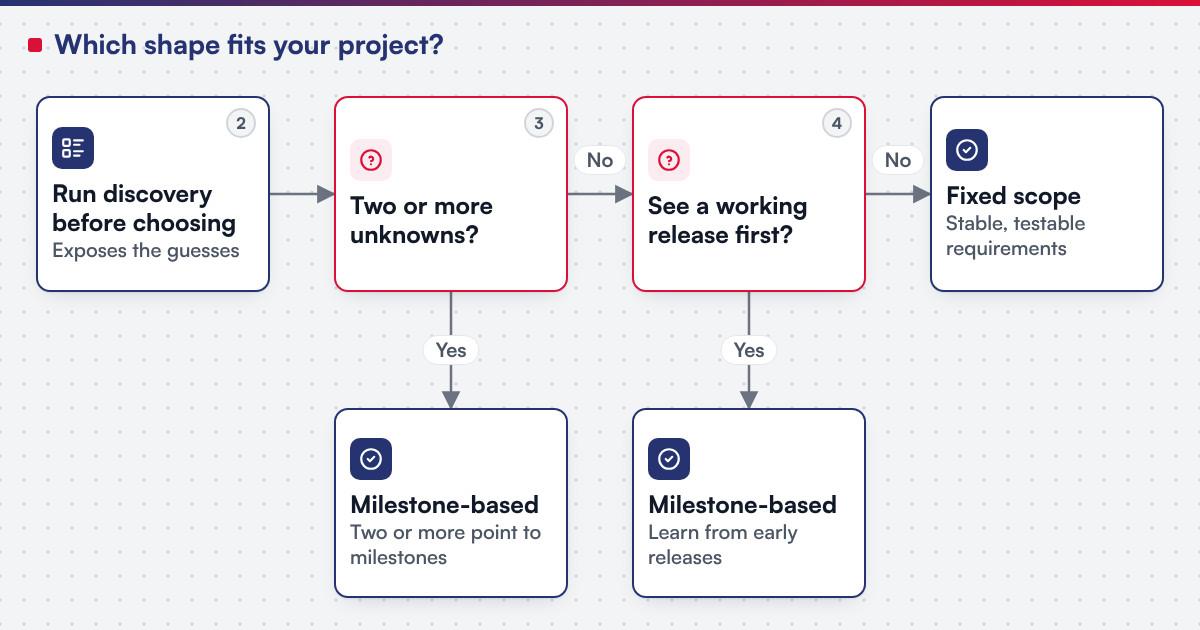 (opens the full-size diagram in a new tab)
How does a milestone contract work in practice?
Netbase's delivery lifecycle runs from discovery and strategic alignment, through team assembly and architecture planning and agile execution with outcome-based milestones, to modular components, training and rollout, and ongoing support. In a milestone contract, each of those execution milestones becomes its own small fixed-scope agreement: a list of deliverables, an acceptance test, a date and a sign-off. The difference from one large fixed-scope contract is that milestone three is written after milestone two is accepted, with what milestone two taught both parties.
Netbase delivery runs with weekly reviews and a named project manager, which is what keeps a milestone contract honest between sign-offs. A weekly review is where a buyer learns early that a milestone is drifting, rather than finding out on the acceptance date.
A delivered example shows the shape. For a founder who is not named, Netbase delivered a bilingual English and Nepali classifieds platform: requirements, design, Laravel backend with REST APIs, OTP accounts, paid ads, search, ratings, messaging, event ticket ads, blog and forum, payments, multi-language SEO and AWS deployment. The classifieds platform record states it was delivered in six milestones over four months with training and six months of support. A platform with that many modules suits milestones because each group of features can be accepted, used and corrected before the next group is built on top of it.
Worked scenario: a clinic-booking product at the contract table
A founder plans a booking product for independent physiotherapy clinics: patient sign-up, clinic calendars, reminders, online payment and an admin view for clinic owners. The founder asks two suppliers for proposals. The scenario is illustrative and describes no client.
- Supplier A offers one fixed-scope contract for the whole product, signed before any discovery, with a long feature list copied from the founder's email.
- Supplier B proposes a two-week discovery, then a fixed-scope first milestone covering sign-up, calendars and reminders, with payments and the admin view outlined as milestones two and three.
The founder chooses B. Discovery shows that two pilot clinics need a deposit rule the founder had not mentioned, and that the chosen payment provider does not support it in one market. Under Supplier A's contract that discovery would have arrived mid-build as a dispute over whether the deposit rule was "in scope". Under B, it simply shapes milestone two, which is written and agreed after milestone one is accepted by the two pilot clinics.
The lesson is not that milestones always win. Had the founder already run a pilot on a no-code tool and written tested rules for every screen, a single fixed-scope contract would have been faster to agree and easier to hold the supplier to.
Which clauses matter whatever shape you choose?
-
Acceptance criteria
- Why it matters
- Defines "done" for each deliverable
- What good looks like
- Testable statements per feature, with who tests and how long they have
-
Change control
- Why it matters
- Stops scope arguments becoming relationship arguments
- What good looks like
- A written request, an impact estimate, and approval before work starts
-
Ownership of work product
- Why it matters
- Decides what you can take with you
- What good looks like
- The client owns the IP created for it; reusable supplier modules are licensed, not transferred
-
Handover and exit
- Why it matters
- Protects you if the relationship ends early
- What good looks like
- Repositories, credentials, documentation and a transfer plan named in the contract
-
Warranty and support
- Why it matters
- Covers defects found after acceptance
- What good looks like
- A defined defect period and a route to ongoing support
-
Reporting cadence
- Why it matters
- Makes drift visible early
- What good looks like
- Weekly reviews with a named project manager and written notes
At Netbase, for custom development the client owns the IP created for it; Netbase reusable modules and products are licensed, not transferred, and final terms are set in each project agreement. The IP ownership guide covers the wording to check, and the handover and exit guide lists what an exit clause should name.
What questions should you ask a supplier about the contract?
- What will discovery produce, and can I keep it if I do not continue? A discovery document you own lets you take the scope to another supplier.
- How are change requests estimated and approved? Ask to see a real change request template, not a promise of flexibility.
- Who signs acceptance on your side, and how long do I have to test? A short test window with no named tester is a warning sign.
- What happens to a milestone that fails acceptance? Look for a fix-and-retest loop before the next milestone starts.
- How do you report between milestones? Weekly written notes beat a monthly demonstration.
- Which parts of the build reuse your own modules, and on what licence? This decides what you own at the end.
What goes wrong with each contract shape?
- Fixed scope signed too early. Signal: the scope is a copy of your first email. Result: every clarification becomes a change request.
- Milestones with no end. Signal: milestone five is still "phase two tasks". Result: a time-and-materials engagement wearing a milestone label. Fix: agree a target number of milestones and a completion definition up front.
- Outcome contracts on outcomes nobody controls. Signal: the metric depends on your marketing spend or stock. Result: disputes about attribution instead of software.
- Acceptance by silence. Signal: "deemed accepted after five days". Result: defects found in week two are argued about as changes.
- Contract shape chosen to win the deal. Signal: fixed scope offered before a single question is asked. Result: hidden contingency, or corners cut later.
How this guide is sourced and where it stops
Statements about Netbase come from approved entries in the OutsourcingVN claim register, published in their registered wording and listed under Sources: the contract shapes Netbase agrees, its delivery lifecycle, weekly reviews, IP terms and the classifieds platform delivered in milestones. The methodology explains how those claims are reviewed. Netbase's published record shows milestone delivery on the classifieds platform; the outcome-based column describes that contract shape in general. Nothing here is legal advice, and no commercial figure, rate or payment term is published on this site.
Plan the next step for your project
Common questions
Not by itself. A fixed-scope contract carries the supplier's contingency for everything uncertain in the scope, while a milestone contract agrees each stage when less is uncertain. The cheaper shape is usually the one whose scope is honest at the moment of signing.
Yes, and it is common. Early milestones settle the unknowns, and the remaining stable work can then be agreed as a single fixed-scope contract. Write the switch point into the first agreement so neither side is surprised.
The buyer owns them, because the buyer decides what "done" means for the business. A supplier can draft them during discovery, but the buyer's tester should be able to run each one without the supplier in the room.
Sometimes a milestone teaches you to change direction, and some work is discarded. That is the point of learning early; a fixed-scope contract that builds the wrong thing completely wastes more.
For research, prototyping or open-ended support, where no one can yet write acceptance criteria. Keep it bounded by a time box and a reporting cadence, and move to fixed scope or milestones once the work becomes definable.
Bring your scope and your unknowns
Project delivery sets out how Netbase runs discovery, milestones, change control and acceptance, and Custom Product Engineering is the service that delivers the build. Engagement models compares the wider ways to work with a supplier.
OutsourcingVN is Netbase's own outsourcing-services platform. Submit a project with what you know, what you are guessing and your target date, and a person will reply with the contract shape that fits and what discovery would need to settle first.
Work behind this guide

Netbase delivered a bilingual classifieds marketplace, in English and Nepali, with paid ads, search, messaging, payments and an AI filter that flags offensive content into an administrator review queue. The client is not named, and no traffic, accuracy or commercial result is claimed.
Keep ReadingRelated services and solutions
 Custom product engineering for a bounded release outcome
One defined release of your product, built to named outcomes and handed over with acceptance evidence.
Learn More