

Laravel mobile app backend: planning the API
A Laravel backend for a mobile app is planned by deciding how resources version as the app evolves, how Sanctum or Passport authenticates a client, how social log-in and device tokens for push notifications are wired in, how a queue carries notifications and media off the request path, and how the app behaves and reconciles while offline.
Submit a project See the mobile commerce apps solutionReviewed by Huy Nguyen (David), CEO · Updated 26 Oct 2026 · 13 min read

OutsourcingVN is operated by Netbase JSC. This guide plans the backend and its API behind any mobile app once Laravel is the chosen framework on the Laravel platform page; a marketplace's own vendor, order and commission rules are planned on Laravel marketplace development, and the client app that calls this API is scoped as mobile app development.
Contents
- What does a Laravel mobile app backend need to decide?
- How does a Laravel mobile backend divide its building blocks?
- How should the backend be built?
- Worked scenario: a field-service app's first release
- What has Netbase built on Laravel for a mobile backend?
- Where does AI fit in a Laravel mobile backend?
- What should you check before committing to the stack?
- What goes wrong in a Laravel mobile app backend build?
- Which questions should you ask a mobile backend supplier?
- How this guide is sourced and where it stops
- Common questions
- Plan your mobile app's backend
What does a Laravel mobile app backend need to decide?
Whether Laravel fits the backend at all is decided on the Laravel platform page; this guide starts once Laravel is the framework and covers the API and backend behind any mobile app, from a single consumer app to the companion app behind a larger product. Six parts carry the build: how resources are versioned as the app evolves without breaking an installed client, how a client authenticates, how a user signs in with a social account, how a device registers for push delivery, how the app behaves while offline and reconciles once a connection returns, and how the API is rate-limited and monitored once real traffic arrives. Where the mobile app is one consumer of a marketplace's own vendor and order API, Laravel marketplace development plans that build instead; where the client is a multi-tenant SaaS product's own app, Laravel SaaS development plans the tenant and billing model first; and where the backend's own data lives in an ERP such as Odoo rather than a bespoke schema, Odoo API integration plans that connection. A shopping app built against a store or marketplace's own commerce API specifically is the mobile commerce apps workflow.
How does a Laravel mobile backend divide its building blocks?
| Backend part | Owned by | Why |
|---|---|---|
| Resource design and versioning | The API | Every installed app version keeps running against the contract it shipped with |
| Token authentication | Sanctum or Passport | A token identifies the client on every request after sign-in |
| Social log-in | Socialite | Signs a user in through a provider; the app creates or matches its own account |
| Device token and push delivery | The push network | Delivery to a closed app runs through Firebase or Apple's own service, outside Laravel |
| Offline write queue | The device | A write made with no connection waits locally until one returns |
| Background jobs | Laravel's queue | A notification or a media job should not block the request that triggered it |
A device's local queue and the API's resource contract are two parts that are easy to skip in a first design pass, and both are expensive to retrofit once a version of the app is already installed on real phones.
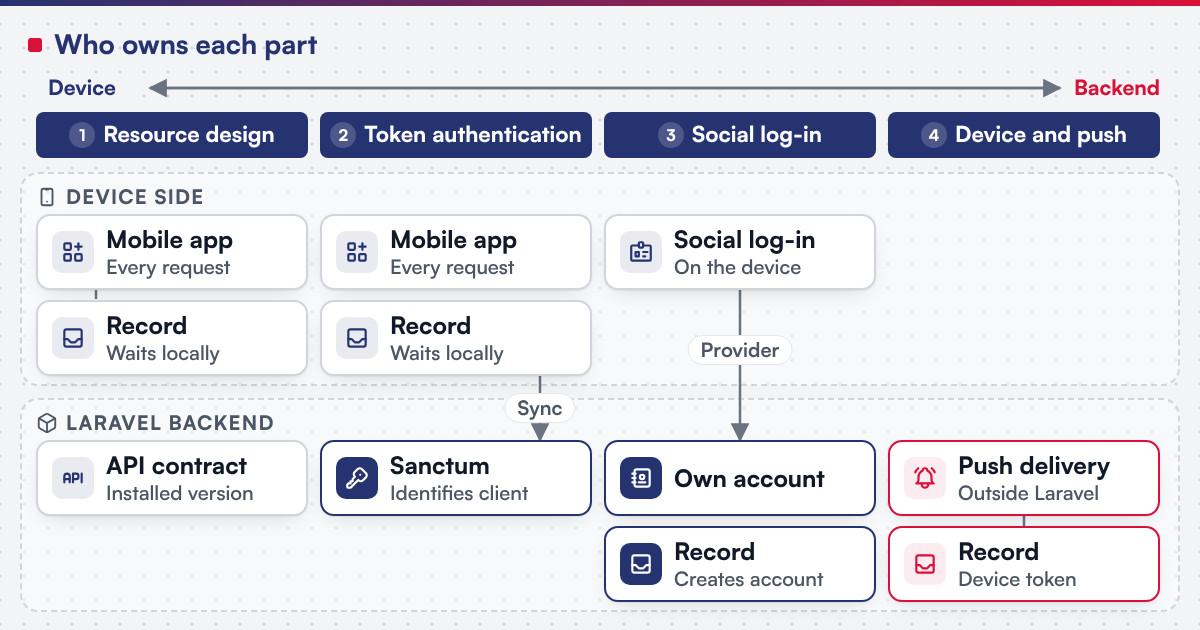 (opens the full-size diagram in a new tab)
How should the backend be built?
-
Design resources and version the API
Decide what a mobile client reads and writes as named resources, and version the contract from day one so a later change never breaks an app version still installed on a user's phone.
-
Wire token authentication
Sanctum issues a long-lived token for a first-party mobile client; Passport is the route only if the API must also support third-party OAuth2 clients, not just your own app.
-
Add social log-in through Socialite
, then create or match the app's own account once the provider confirms the user, rather than treating the provider's identity as the account itself.
-
Register device tokens and send push notifications
through Firebase Cloud Messaging for Android and Apple's push service for iOS, queued and retried like any other outbound call rather than sent inline on the request that triggers them.
-
Move notifications and media processing onto a queue
, so an image upload, a transcode or a bulk notification run does not hold a mobile request open while it works.
-
Define offline behaviour and the conflict rule
Decide what the app may read and queue for later write while offline, and which side wins when a queued write conflicts with a change made elsewhere in the meantime.
-
Rate-limit the API and ship the administrator panel
, then monitor real traffic and version every later release so an older installed app keeps working against the contract it shipped with.
Worked scenario: a field-service app's first release
A hypothetical field-service operator builds a technician app against a new Laravel backend before its first crew goes live. The API exposes job, customer and visit resources behind a version prefix, so a later change to how a visit is represented ships as a new version rather than breaking the app already on technicians' phones. Sanctum issues each technician a token on log-in, and the API's authorisation rules limit each technician to the visits assigned to them rather than the whole job list. A technician often loses signal inside a building, so the app queues a completed visit locally and the backend's conflict rule lets the first write for a visit win, flagging a second conflicting write for a dispatcher to resolve rather than silently discarding it. A queued job sends a push notification through Firebase Cloud Messaging when a new job is assigned, and the same queue handles the photo uploads a technician attaches to a completed visit, so neither holds the mobile request open while it runs.
What has Netbase built on Laravel for a mobile backend?
For RB Marketplace, Netbase built the customer REST API with device tokens and notifications behind an English-first multi-vendor marketplace for West Africa on Laravel. Netbase built its customer shopping app on that API: Android, with iOS in the extended scope, with push notifications for order, sale and stock alerts, Google, Facebook and Apple sign-in, and offline browsing. The RB Marketplace record describes that build. Separately, for a founder who is not named, Netbase delivered a classifieds platform with a Laravel backend, REST APIs and OTP accounts. The classifieds platform record describes that platform.
Plan the next step for your project
Where does AI fit in a Laravel mobile backend?
Three AI tasks fit behind a mobile app: drafting a push notification's copy from the event that triggered it for a person to approve, triaging an inbound support message before a human reads it, and flagging an unusual pattern in the offline sync queue, such as a device that keeps producing the same conflict, for a person to investigate. None of it replaces the versioning, authentication or conflict rules this guide plans. Custom product engineering scopes where an AI feature belongs against where a rate limit or a conflict rule already does the job.
What should you check before committing to the stack?
Laravel's own release notes state that Laravel 13 requires PHP 8.3 as its minimum version, with bug fixes for 18 months and security fixes for 2 years on every release. Its Sanctum documentation describes "a featherweight authentication system for SPAs (single page applications), mobile applications, and simple, token based APIs," issuing a token used as a Bearer value in the Authorization header, with scoped abilities and no expiration by default. Its Passport documentation describes "a full OAuth2 server implementation" and recommends it only when an application "absolutely needs to support OAuth2," steering a single first-party mobile client back to Sanctum instead. Its Socialite documentation lists Facebook, X, LinkedIn, Google, GitHub, GitLab, Bitbucket and Slack as supported providers, with other platforms available through community-built adapters. Firebase's own Cloud Messaging documentation describes messages sent from a trusted environment, such as an app server, to single devices, groups of devices or devices subscribed to topics, with the sender managing each device's registration token. Apple's own developer documentation describes a provider server sending a notification request to Apple's push service with the device token that identifies the user's device, validated with either an authentication token or the server's certificate. Apple's App Store Review Guidelines require screenshots that show the app in use rather than a login or splash screen, and Google Play's own release documentation describes changes that may need review before they publish, with an app that requests high-risk or sensitive permissions possibly needing a Permissions Declaration Form. Its routing documentation describes rate limiters attached to a route group through the throttle middleware, returning a 429 response once a client exceeds its limit. The relational store behind the API's own resource, device-token and queue tables is typically MySQL or PostgreSQL, chosen the way any Laravel application chooses its primary database. Confirm before scoping a build:
- Which token mechanism the client actually needs: Sanctum for your own mobile app, Passport only if a third-party OAuth2 client must also connect.
- Which Socialite providers the app needs, and which require a community adapter rather than a built-in driver.
- Which Laravel major version is in scope, and its PHP floor, checked against the current release notes rather than an older tutorial.
- What a rate limiter protects, and which routes need a tighter or looser limit than the rest of the API.
What goes wrong in a Laravel mobile app backend build?
- No version prefix on the API. A field renamed or removed without a new version breaks every app still installed with the old contract, not just the next release.
- Push notifications assumed delivered once sent. A push is handed to Firebase or Apple's own service, which decides final delivery; the backend only knows it queued the message, not that a phone showed it.
- Offline writes with no conflict rule. Two queued writes for the same record, synced in whichever order the connection returns, silently overwrite one another without a rule to say which should win.
- Rate limiting bolted on after a launch spike. A limiter added after traffic has already degraded the API is a harder change than one scoped from the first release.
Which questions should you ask a mobile backend supplier?
- How is the API versioned, and what happens to an installed app when a resource's shape changes?
- Which token mechanism authenticates the app, and does the API need to support a third-party client at all?
- What does the app do while offline, and which side wins when a queued write conflicts with a later change?
- Who owns the code once the backend ships?
- How is scope fixed? Most Netbase projects are agreed as fixed-scope contracts after discovery, with milestone-based arrangements also available.
How this guide is sourced and where it stops
The Laravel, Sanctum, Passport and Socialite facts are read from Laravel's own documentation; the push facts from Firebase's and Apple's own developer documentation; and the review and publishing facts from Apple's and Google's own pages, on the dates cited. Netbase's delivery lifecycle: discovery and strategic alignment; team assembly and architecture planning; agile execution with outcome-based milestones; modular components; training and rollout; ongoing support. The build sequence and the field-service scenario are editorial planning guidance.
Common questions
Sanctum is enough for a first-party mobile app issuing its own tokens; Passport is the route only once a third-party OAuth2 client must also connect to the same API.
Socialite, which exchanges a supported provider's token for the user's profile details; the app then creates or matches its own account from that profile rather than storing the provider's identity as the account.
Laravel queues and sends the request to Firebase Cloud Messaging or Apple's push service using the device's registration token; from there, delivery to the device itself is outside Laravel's own code.
A versioned contract keeps the previous version's resources working unchanged while a new version carries the change, so an app that has not updated keeps functioning until its user does.
For custom development the client owns the IP created for it; Netbase productized modules and products are licensed, not transferred.
The RB Marketplace record, whose customer API and shopping app are described in the chapter on what Netbase has built on Laravel, with the classifieds platform record beside it.
Plan your mobile app's backend
Bring the resources your app reads and writes, which sign-in providers it needs, and whether offline use is part of the first release. Custom product engineering scopes the backend itself, and mobile app development scopes the client app that calls it.
OutsourcingVN is Netbase's own outsourcing-services platform. Submit a project with your resource list and authentication requirements, and a person will reply with the fit.
Work behind this guide

Netbase delivered a bilingual classifieds marketplace, in English and Nepali, with paid ads, search, messaging, payments and an AI filter that flags offensive content into an administrator review queue. The client is not named, and no traffic, accuracy or commercial result is claimed.
Keep Reading
This record sets out what was delivered on each side, what deliberately stayed in the web panel, and what the project documents do not support.
Keep ReadingRelated services and solutions
 Mobile app development on your platform's API
A customer or field app built on your platform's API, with an audit first and a phased release.
Learn More