

Germany software delivery: the BDSG, works councils, accessibility and e-invoicing
German buyers add two decisions most other markets skip entirely: whether a works council must agree to a system before it goes live, and which federal data protection act provisions sit on top of GDPR. Settle those, plus the accessibility standard and the invoice format a German business partner expects, before a proposal is comparable.
Submit a project Explore custom engineeringReviewed by Huy Nguyen (David), CEO · Updated 24 Oct 2026 · 12 min read

OutsourcingVN is operated by Netbase JSC, so this guide comes from a supplier that would like your project. It draws on Germany's own statutory texts for the questions your legal and works-council advisers should answer, and on Netbase's published delivery and compliance statements. The guides index lists guides for other markets, and the market index compares the first question each one raises.
Contents
- How does German law sit on top of GDPR?
- Why does a works council matter for a monitoring-capable system?
- What can Netbase evidence for a German brief?
- Which requirement sits with which decision owner?
- Which steps come before a German-facing launch?
- Worked scenario: a support dashboard needs works-council agreement
- What has Netbase built in Europe?
- Which questions should you ask a supplier?
- What usually goes wrong?
- How this guide is sourced and where it stops
- Common questions
- Plan the first release
How does German law sit on top of GDPR?
Germany implements GDPR through the Bundesdatenschutzgesetz (BDSG), a federal act that fills the gaps GDPR leaves to member states rather than replacing the regulation itself. It sets specific rules for processing employee data under its own section on employment-related purposes, and it requires both public bodies and many private organisations to appoint a data protection officer once certain thresholds are met. Supervision is federal rather than centralised in one office: the Bundesbeauftragte für den Datenschutz (BfDI) supervises federal bodies, while each of the sixteen states runs its own data protection authority for organisations under state jurisdiction.
A buyer should confirm early which authority has jurisdiction over the system being built, who inside the business holds the data protection officer role, and how the BDSG's employee-data provisions apply if the product itself processes staff records.
Why does a works council matter for a monitoring-capable system?
Germany's Works Constitution Act (Betriebsverfassungsgesetz) gives an elected works council co-determination rights over social matters at a company, a category that reaches the introduction of technical devices capable of monitoring employee behaviour or performance. A system does not have to be built for surveillance to trigger this: a support dashboard that logs who handled which ticket, or an analytics tool that times a workflow step, can still fall inside it if the council judges that it could be used to watch performance.
Where a works council exists, the usual route is a works agreement (Betriebsvereinbarung) negotiated before the system goes live, not after staff notice it running. A buyer should name this as a project dependency as early as discovery, because a late works-council objection can hold up a release that is otherwise complete.
What can Netbase evidence for a German brief?
Procurement, security and data protection reviewers tend to ask the same four questions. Here is what Netbase can state.
- Delivery process. Netbase delivery runs with weekly reviews and a named project manager, which gives a works council and a data protection officer a fixed point to raise a question as the build progresses.
- Compliance practices. Netbase's compliance practices are GDPR alignment for data privacy in Europe, HIPAA-aligned methodologies for healthcare data handling, and CCPA compliance for clients with U.S. customer bases. How the BDSG's own provisions apply to a specific German product stays with your organisation's advisers.
- Security and certification. Security practices include secure code review and version control, role-based access control, MFA for admin dashboards, contributors under NDA, and NDAs and DPAs on request. Netbase JSC holds ISO 27001 certification for information security management, and Netbase JSC holds a SOC 2 Type II attestation; neither extends to a client's own product or hosting.
- Language. Netbase delivery communication is in English. German-language requirements, such as a works agreement text or German-language user interface copy, are scoped as a project task with a named German-speaking reviewer.
Which requirement sits with which decision owner?
A German brief usually involves four separate owners inside the buying organisation, and conflating them is the fastest way to lose weeks to a late objection.
| Decision area | What German rules expect | What a supplier can evidence | Who decides |
|---|---|---|---|
| Data protection | BDSG rules on top of GDPR, a data protection officer once thresholds are met | A data processing agreement, an access matrix, role-based access controls | Data protection officer |
| Works council | Co-determination before a monitoring-capable system goes live | A feature list describing exactly what is logged and why | Works council with HR |
| Accessibility | A widening private-sector duty under the Accessibility Strengthening Act (BFSG) | Per-journey test results with assistive technology | Product owner |
| E-invoicing | Public-sector invoices in XRechnung or an EN 16931-compliant format such as ZUGFeRD | A tested invoice export in the agreed format | Finance systems owner |
Ask a shortlisted supplier to fill this table in for your specific product rather than accept a general compliance statement.
Which steps come before a German-facing launch?
-
Map the data flows under the BDSG
List what personal data the product processes, the lawful basis, and whether a data protection officer is required for this scope.
-
Consult the works council on monitoring capability
Describe exactly what the system logs about staff behaviour or performance, and start the works-council conversation before the build is finished.
-
Name the accessibility standard
Decide whether the BFSG's private-sector duties reach this product, and what standard it will commit to either way.
-
Choose the e-invoicing format
Support XRechnung or ZUGFeRD for invoices to public-sector partners, and plan for a wider business e-invoicing obligation.
-
Decide go-live readiness
Check the data protection sign-off, the works-council agreement, the accessibility test and the invoice format against the plan, and record the decision with its owner.
-
Launch and keep the agreement current
File the signed works agreement, publish or update the accessibility statement, and revisit all four items at the next major release.
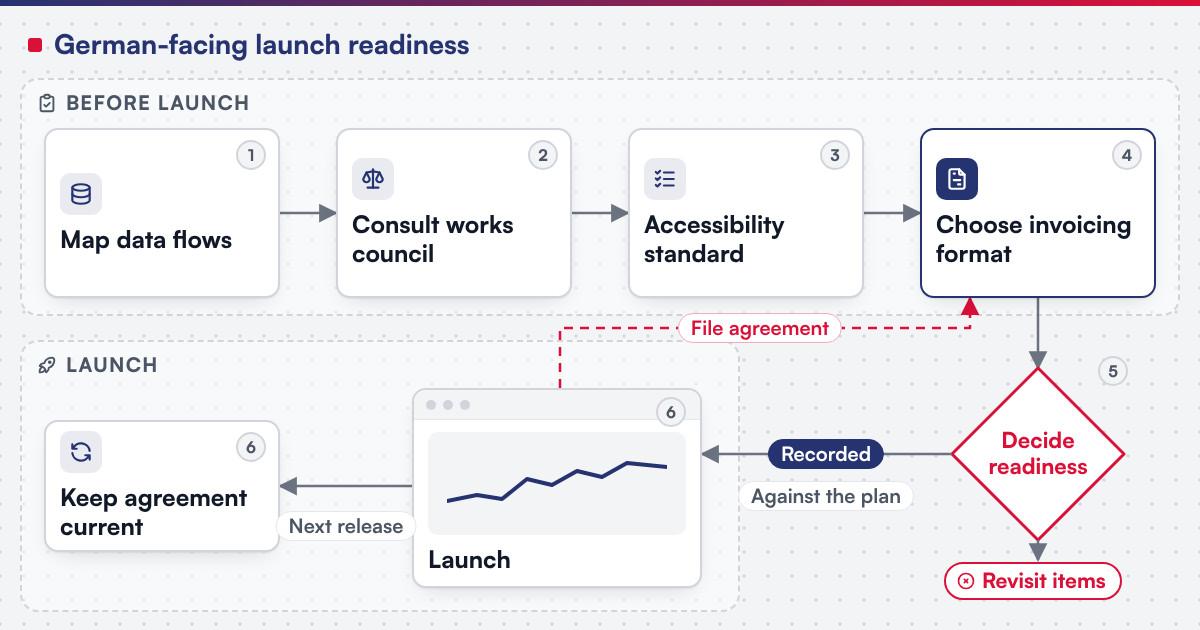 (opens the full-size diagram in a new tab)
Worked scenario: a support dashboard needs works-council agreement
A project adds a dashboard that shows which support agent handled which ticket and how long each one took, to help a German subsidiary plan staffing.
-
Feature proposed
The dashboard's fields and metrics are written down before any code is built
- Owner
- Product owner
-
Works council notified
HR shares the feature description with the works council ahead of the build
- Owner
- HR with the works council
-
Monitoring capability assessed
The council checks whether the metrics could be read as individual performance tracking
- Owner
- Works council
-
Agreement negotiated
A works agreement sets what is shown, to whom, and for how long data is kept
- Owner
- HR with the works council
-
Agreement signed
The works agreement is signed before the dashboard is switched on for live data
- Owner
- Works council and HR
-
Dashboard deployed
The system goes live with the agreed fields only, and the agreement is filed with the project record
- Owner
- Product owner
A proposal that skips step 2 and goes straight to building the dashboard risks a signed, working feature that still cannot be switched on.
What has Netbase built in Europe?
The closest published example of comparable engineering work in Europe is a 3D product preview delivered for Rebelo AG, a printer in Portugal: a preview inside the online designer for boxes and other multi-sided products, configured by uploading a 3D model file per product, with a go-live timeline of about three and a half months. The Rebelo AG record names the client and the results it reported, and describes Portuguese delivery. The web-to-print stores record covers design-tool work across four countries and shows the same custom-engineering practice applied to European and Asian clients alike. Separately, Netbase JSC's Clutch profile carries client reviews from businesses in seven European countries, published between October 2020 and June 2021.
Which questions should you ask a supplier?
- Has your project plan named a works-council step, or does it assume there is none? A German subsidiary of almost any size may have one.
- What exactly does your logging or analytics feature record about individual staff? Write the answer down before the works council sees it, not after.
- Which data protection officer role applies, yours or ours? The answer depends on thresholds your advisers should confirm.
- Can your invoice export produce XRechnung or ZUGFeRD today? Ask to see a sample file, not just a claim that the format is supported.
- Who signs the works agreement, and where is it filed? It should sit with the project record, not in an email thread.
- What does your security and certification statement cover, and what does it not? A precise answer names the boundary.
What usually goes wrong?
- A monitoring-capable feature is built before the works council sees it. Signal: a finished feature that cannot be switched on. Owner: HR with the works council, consulted at discovery.
- BDSG is treated as identical to GDPR with a German label. Signal: no named data protection officer, no employee-data-specific review. Owner: the data protection officer.
- Accessibility is scoped only for the public sector. Signal: a private product skips testing because "BFSG is a public-sector law." Owner: the product owner, checking whether the widening private-sector duty applies.
- An invoice export is built once and never tested against XRechnung validation. Signal: invoices bounce at a public-sector buyer's gateway. Owner: the finance systems owner.
How this guide is sourced and where it stops
This guide uses the German government's own texts for the BDSG, the Works Constitution Act and the Accessibility Strengthening Act, the BfDI's description of its own supervisory role, and the XRechnung and e-Rechnung-Bund descriptions of German e-invoicing formats, all checked on 2026-10-03, together with company statements and a delivery record approved in the OutsourcingVN claim register. It is written for product, operations and procurement leads preparing a German-facing brief. It does not decide whether a works council exists at your organisation or which accessibility duty reaches your product; your own advisers confirm that.
Plan the next step for your project
Common questions
No. A works council forms where employees choose to establish one, most often at larger employers; a buyer should check with its own German entity or subsidiary rather than assume either way.
No. XRechnung is the standard built for public-sector invoicing, and formats such as ZUGFeRD that meet the EN 16931 European standard are also used; check which format a specific public-sector partner's system accepts.
It implements an EU accessibility directive that reaches many private-sector products and services, not only public-sector ones; your own advisers should confirm whether a specific product falls inside its scope.
The negotiation and signature sit with your organisation's HR and the works council; a supplier's role is to describe the feature precisely enough for that conversation to happen on real information.
The Rebelo AG project is the closest published European example of comparable engineering work, described as Portuguese because that is where it was delivered; the same method and practices apply to a German-facing build.
Plan the first release
Bring your BDSG scope, your works-council status, your accessibility decision and your e-invoicing format. The data security and compliance guide lists the contract questions behind the data protection row, and the IP ownership guide covers who owns what a German-facing build produces. For other European markets, the UK guide covers UK accessibility duties, the Netherlands guide covers Peppol e-invoicing and the Dutch supervisory authority, the France guide covers CNIL guidance and the French e-invoicing reform, the Sweden guide covers BankID, Swish and Peppol e-invoicing to the public sector, and the Romania guide covers RO e-Factura and ANSPDCP's GDPR enforcement, the Poland guide covers KSeF e-invoicing and GDPR enforcement by Poland's own data protection office, and the Switzerland guide covers the revised FADP and the federal e-ID for a neighbouring German-speaking market outside the EU. Choosing where to deliver into Germany is a different question from choosing where to source the engineering team from; Vietnam vs Poland for software outsourcing compares two sourcing locations for a European buyer on that second question.
Custom Product Engineering is the service for a bounded build, and global delivery explains how remote delivery is organised. OutsourcingVN is Netbase's own outsourcing-services platform: submit a project with your German-facing scope, and a person will reply with whether discovery or a bounded implementation is the right next step.
Work behind this guide

Go-live took about three and a half months.
Keep Reading
The stores run on WooCommerce and WordPress, with a design tool in Angular JS or Vue.js and PDF generation for production files.
Keep ReadingRelated services and solutions
 Custom product engineering for a bounded release outcome
One defined release of your product, built to named outcomes and handed over with acceptance evidence.
Learn More
Sources
- Bundesministerium der Justiz, Federal Data Protection Act (BDSG)
- Die Bundesbeauftragte für den Datenschutz und die Informationsfreiheit (BfDI)
- Bundesministerium der Justiz, Works Constitution Act (Betriebsverfassungsgesetz)
- Bundesministerium der Justiz, Barrierefreiheitsstärkungsgesetz (BFSG)
- KoSIT, XRechnung
- e-Rechnung-Bund, federal e-invoicing platform