

France software delivery: CNIL, RGAA, the e-invoicing reform and French-language rules
A French-facing release carries four decisions that a generic EU GDPR checklist will not surface on its own: how CNIL's own guidance shapes a data protection programme, which RGAA accessibility criteria apply, how the phased e-invoicing reform changes an invoice's required fields, and where the Toubon law requires French rather than English. Settle those before a proposal is comparable.
Submit a project Explore custom engineeringReviewed by Huy Nguyen (David), CEO · Updated 20 Oct 2026 · 11 min read

OutsourcingVN is operated by Netbase JSC, so this guide is written by a supplier that would like your project. It draws on France's own regulator and legislative texts for the questions your advisers should answer in full, and on Netbase's published delivery and compliance statements. The guides index lists guides for other markets, and the market index compares the first question each one raises.
Contents
- How does CNIL shape a French data protection programme?
- What can Netbase evidence for a French brief?
- Which requirement sits with which decision owner?
- Which steps come before a French-facing launch?
- Worked scenario: a French partner rejects an invoice
- What has Netbase built for French clients?
- Which questions should you ask a supplier?
- What usually goes wrong?
- How this guide is sourced and where it stops
- Common questions
- Plan the first release
How does CNIL shape a French data protection programme?
GDPR is the regulation; the Commission Nationale de l'Informatique et des Libertés (CNIL) is the French authority that supervises it, investigates complaints and can impose sanctions, including fines that have reached hundreds of millions of euros against large platforms. CNIL also publishes its own compliance toolkit covering records of processing, impact assessments and certification-style guidance, which French data protection officers often use as the working reference rather than the regulation's text alone.
For a buyer, the practical effect is that a data protection programme written only against the regulation's general wording can still miss what a French reviewer expects to see, because CNIL's guidance adds its own structure and vocabulary on top. A buyer's data protection lead should check CNIL's current guidance directly rather than relying on a generic EU summary.
What can Netbase evidence for a French brief?
Procurement, security and data protection reviewers tend to ask for the same set of statements. Here is what Netbase can provide.
- Compliance practices. Netbase's compliance practices are GDPR alignment for data privacy in Europe, HIPAA-aligned methodologies for healthcare data handling, and CCPA compliance for clients with U.S. customer bases. How CNIL's own guidance applies to a specific French product stays with your organisation's advisers.
- Security practices. Security practices include secure code review and version control, role-based access control, MFA for admin dashboards, contributors under NDA, and NDAs and DPAs on request. A data processing agreement for a France-facing system sits on top of this baseline.
- Markets. Netbase clients are in the United States, Europe and Asia-Pacific, and most projects come from clients outside Vietnam.
- Language. Netbase delivery communication is in English. French-language requirements for the product itself, such as Toubon-law copy on invoices or product pages, are scoped as a project task with a named French-speaking reviewer.
Which requirement sits with which decision owner?
A French brief usually spans four separate owners inside the buying organisation, and treating them as one generic "compliance" line is the quickest way to miss one of them.
| Decision area | What French rules expect | What a supplier can evidence | Who decides |
|---|---|---|---|
| Data protection | CNIL guidance on top of GDPR, a documented record of processing | A data processing agreement, an access matrix, a tested breach-response plan | Data protection lead |
| Accessibility | RGAA criteria for public-sector sites; a widening private-sector duty | Per-journey test results against the RGAA criteria, a defect log | Product owner |
| E-invoicing | A phased mandate adding required fields and routing invoices through a registered platform | A tested invoice export with the required fields, entered in the national directory | Finance systems owner |
| Language | French required on product descriptions, invoices, receipts and advertising, with limited exceptions | A named French copy owner and a tested translation workflow | Localisation owner |
Ask a shortlisted supplier to complete this table for your specific product rather than accept one general compliance paragraph.
Which steps come before a French-facing launch?
-
Map the data flows and lawful basis
List what personal data the product collects, stores or shares, and check the approach against CNIL's current guidance as well as the regulation itself.
-
Name the accessibility standard
Decide whether RGAA's public-sector duty reaches this product, and which of its criteria the team commits to either way.
-
Plan for the e-invoicing reform
Register in the national e-invoicing directory and connect through a registered platform so invoices carry the fields the reform requires.
-
Decide the French-language scope
Fix which product descriptions, invoices, receipts and advertising must be in French under the Toubon law, and who signs off French copy.
-
Decide go-live readiness
Check the data protection sign-off, the accessibility test, the invoicing connection and the language scope against the plan, and record the decision with its owner.
-
Launch and keep the record current
Publish or update the accessibility statement, keep the invoicing connection tested, and revisit all four items at the next major release.
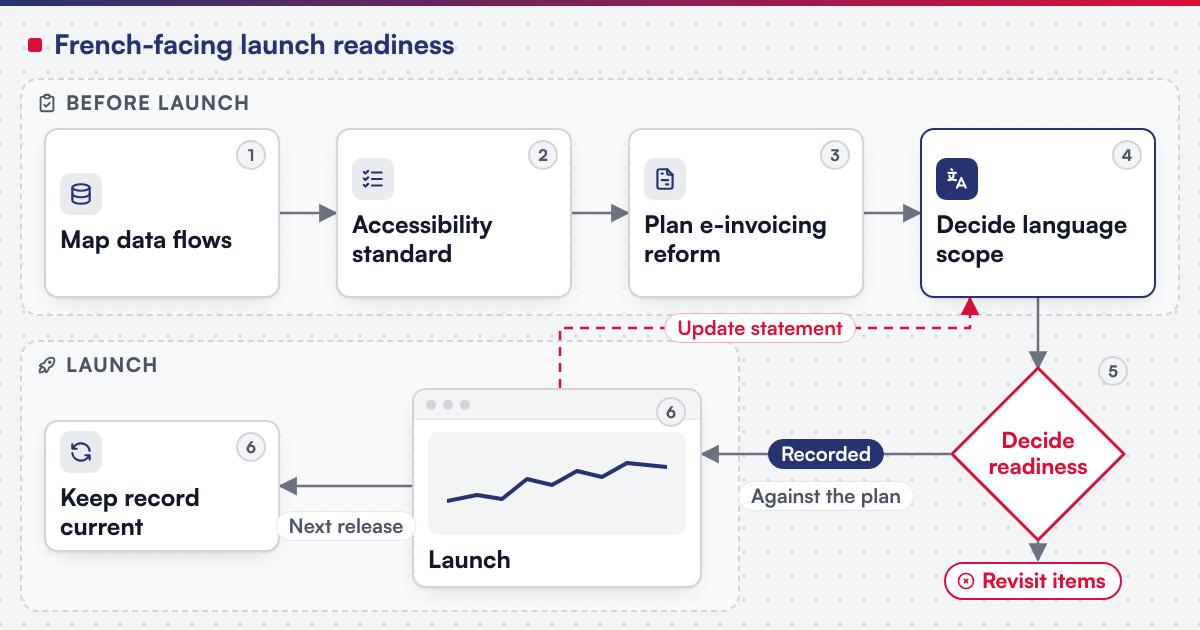 (opens the full-size diagram in a new tab)
Worked scenario: a French partner rejects an invoice
A business customer's platform rejects an invoice because it is missing a field the e-invoicing reform now requires and because its line items are in English only.
-
Invoice issued
The invoice is generated and sent through the agreed e-invoicing path
- Owner
- Finance systems
-
Invoice rejected
The partner's platform returns it, citing a missing required field and the English-only line items
- Owner
- Finance systems
-
Cause found
The team checks the invoice against the reform's required fields and the Toubon-law language rule
- Owner
- Finance systems with product
-
Invoice corrected
The missing field is added and the line items are produced in French as well as English
- Owner
- Product with a French copy owner
-
Invoice resent
The corrected invoice is sent again through the registered platform and accepted
- Owner
- Finance systems
-
Template fixed
The invoice template is updated so every future invoice includes the field and the French text automatically
- Owner
- Product owner
A proposal that treats e-invoicing and the language rule as two unrelated checklist items, rather than one invoice template to get right once, tends to repeat this failure on the next invoice run.
What has Netbase built for French clients?
The nearest published evidence for a French brief is commerce work: Netbase has built a web-to-print store with an online design tool for a canvas-prints business in France, including a live product preview that shows the finished canvas before the customer orders it, for a client that is not named. The web-to-print stores record covers that design-tool scope, and the product personalisation and online design solution covers the customer-facing configurator pattern a live preview like this sits inside. Separately, Netbase JSC's Clutch profile carries client reviews from businesses in Romania, Spain, Sweden, France, Denmark, the Netherlands and Belgium, published between October 2020 and June 2021.
Which questions should you ask a supplier?
- Does your data protection programme reference CNIL's own guidance, or only the regulation's text? A precise answer names which CNIL documents it follows.
- Can you show an invoice that already carries the reform's required fields? Ask for a sample, not a description.
- Who owns the French copy on invoices, product pages and advertising? Expect a named reviewer, not "the developer will translate it."
- How do you test against RGAA's criteria, and who signs off the result? Look for a defect log tied to specific criteria, not a general accessibility claim.
- What happens if a French partner rejects an invoice? A good answer describes a short correction loop, not a one-off fix.
- What exactly does your security and compliance statement cover? A precise answer says what it leaves out as well as what it includes.
What usually goes wrong?
- A data protection programme is written to the regulation and never checked against CNIL's own guidance. Signal: a French reviewer asks for a document the programme does not have. Owner: the data protection lead.
- Accessibility testing starts from a generic WCAG checklist instead of RGAA's own criteria. Signal: a defect list that does not map to anything a French auditor would recognise. Owner: the product owner.
- The e-invoicing reform and the French-language rule are scoped as two separate, unrelated tasks. Signal: the same invoice template fails twice, once for each reason. Owner: the finance systems owner, scoping both in the same template change.
- French copy is translated once at launch and never reviewed again. Signal: invoices and product pages drift back toward English after the first few releases. Owner: the localisation owner.
How this guide is sourced and where it stops
This guide uses CNIL's own description of its supervisory role, the French digital accessibility service's description of RGAA, Légifrance's text of the Toubon language law, and the French government's own description of the e-invoicing reform, all checked on 2026-10-03, together with company statements and a delivery record approved in the OutsourcingVN claim register. It is written for product, procurement and operations leads preparing a French-facing brief. It does not decide which RGAA criteria or language scope fits your product; your own advisers confirm that.
Plan the next step for your project
Common questions
CNIL's guidance explains how the regulation applies in France and is the reference French reviewers typically expect; your own legal advisers should confirm how a specific piece of guidance applies to your product.
The reform is phased by company size, with larger companies required to comply first and smaller ones following in later phases; check the current phase dates with your own finance and tax advisers before committing to a go-live date.
The Toubon law reaches specific commercial content such as product descriptions, invoices, receipts and advertising, with an exception for well-known foreign names; it is not a blanket rule for every page, so check which content types apply.
The registration itself is usually the buyer's own administrative step, while a supplier's role is making sure the product's invoice export produces the fields and format the chosen platform accepts.
RGAA is France's own accessibility framework with its own criteria and testing method; treat it as the reference for a French-facing public-sector duty rather than assuming a WCAG-only test plan covers the same ground.
Plan the first release
Bring your CNIL-referenced data protection programme, your RGAA accessibility decision, your e-invoicing connection and your French-language scope. The data security and compliance guide lists the contract questions behind the data protection row. For other European markets, the UK guide covers UK accessibility duties, the Netherlands guide covers Peppol e-invoicing and the Dutch supervisory authority, the Germany guide covers works-council consultation and German e-invoicing formats, the Sweden guide covers BankID, Swish and Peppol e-invoicing to the public sector, the Romania guide covers RO e-Factura e-invoicing and the Romanian supervisory authority for another EU market, and the Spain guide covers the Verifactu invoicing-software rules and the AEPD's own GDPR enforcement.
Custom Product Engineering is the service for a bounded build, and global delivery explains how remote delivery is organised. OutsourcingVN is Netbase's own outsourcing-services platform: submit a project with your French-facing scope, and a person will reply with whether discovery or a bounded implementation is the right next step.
Work behind this guide

Netbase built web-to-print stores with online design tools for print businesses in Singapore, France, the Netherlands and South Korea.
Keep ReadingRelated services and solutions
 Custom product engineering for a bounded release outcome
One defined release of your product, built to named outcomes and handed over with acceptance evidence.
Learn More
Sources
- Commission Nationale de l'Informatique et des Libertés (CNIL)
- Direction interministérielle du numérique (DINUM), Référentiel général d'amélioration de l'accessibilité (RGAA)
- Légifrance, Law 94-665 on the use of the French language (loi Toubon)
- Entreprendre.Service-Public.fr, French e-invoicing reform