

Odoo implementation for food and beverage chains: planning the outlet rollout
An Odoo implementation for a food and beverage chain works when restaurant point of sale, kitchen orders, recipes as bills of materials, central-kitchen production, perishable stock and purchasing per outlet all run from one system instead of a spreadsheet each; configure the modules first, then prove the pattern on one outlet before rolling out the rest.
Submit a project See the Odoo implementations recordReviewed by Huy Nguyen (David), CEO · Updated 22 Oct 2026 · 12 min read

OutsourcingVN is operated by Netbase JSC. This guide sets out an outlet-by-outlet Odoo implementation plan for a food and beverage chain or franchise, from the blueprint to a stabilised rollout.
Contents
- What does a food and beverage chain's Odoo rollout need to cover?
- Which Odoo modules cover which part of the operation?
- How should the outlet rollout be sequenced?
- Worked scenario: a six-outlet fast-casual chain's pilot
- What has Netbase delivered for food and beverage operations?
- Where does AI fit in a food and beverage chain's Odoo rollout?
- What should you check before committing to the stack?
- What goes wrong in a food and beverage chain's Odoo rollout?
- Which questions should you ask an Odoo implementation supplier?
- How this guide is sourced and where it stops
- Common questions
- Plan your outlet-by-outlet Odoo rollout
What does a food and beverage chain's Odoo rollout need to cover?
Whether Odoo is the right platform at all is decided on the Odoo platform page, and whether to configure Odoo, extend it or build a custom ERP instead is decided in Odoo vs custom ERP; this guide starts once Odoo has been chosen. A retail chain's rollout centres on store replenishment and point of sale for goods it does not prepare, and Odoo implementation for retail chains sequences that instead; a distributor's rollout centres on warehouse routes and landed costs, covered in Odoo implementation for distributors; a plant's rollout centres on routings and work centres, covered in Odoo implementation for manufacturers. A chain whose outlets also prepare food needs a different mix: recipes that double as bills of materials, kitchen order routing, a central kitchen that feeds several outlets, stock that expires, and franchisee reporting that rolls up into one set of reports, sequenced here outlet by outlet.
Food and agriculture covers the wider sector context; this guide stays on the outlet rollout itself.
Which Odoo modules cover which part of the operation?
| Chain operation | Odoo module or feature | What it usually replaces |
|---|---|---|
| Till sales and kitchen orders | Point of Sale with restaurant floors, tables and kitchen order printing | A paper ticket rail or shouted orders to the kitchen |
| Recipes and prepared items | Bills of materials, including a kit-type bill for an assembled item | A recipe card or a prep sheet |
| Central kitchen production | Manufacturing orders that supply several outlets from one kitchen | A central kitchen's own spreadsheet production list |
| Perishable stock | Lots with expiration, best-before, removal and alert times | A handwritten use-by label or a manager's memory |
| Purchasing per outlet | Reordering rules and purchase agreements scoped per outlet | A manual reorder call made outlet by outlet |
| Franchisee reporting | Branches under the parent company's chart of accounts, or separate companies in one database | A spreadsheet each outlet or franchisee sends in separately |
How should the outlet rollout be sequenced?
-
Blueprint the rollout
Document each outlet's recipes, kitchen routing, purchasing rules, perishable-stock policy and franchisee reporting, and map them onto Odoo's Point of Sale, Manufacturing, Inventory, Purchase and Accounting modules.
-
Pilot one outlet
Configure and run the rollout on a single representative outlet first, including its kitchen routing, recipes and perishable-stock policy, so the pattern is proven before it repeats.
-
Migrate recipe, supplier and franchisee data
Move bills of materials, supplier records, open purchase orders and franchisee accounts from the legacy systems, reconciled against the pilot outlet's real numbers; legacy data migration planning covers that reconciliation in full.
-
Rehearse the cutover and the rollback
Run the pilot outlet on Odoo alongside its old process for a full trading cycle, and rehearse the rollback before anyone decides to proceed.
-
Decide go or no-go for the next wave
A named owner checks the pilot outlet's stock accuracy, kitchen ticket times and accounting close against the legacy baseline before approving the remaining outlets.
-
Roll out outlet by outlet
Repeat the configured pattern across the remaining outlets in scheduled waves, verifying each outlet's recipes and perishable-stock set-up before the next wave starts.
-
Stabilise and hand over
Close out exceptions, confirm franchisee reporting and perishable-stock alerts are live everywhere, and hand over the system with training and support.
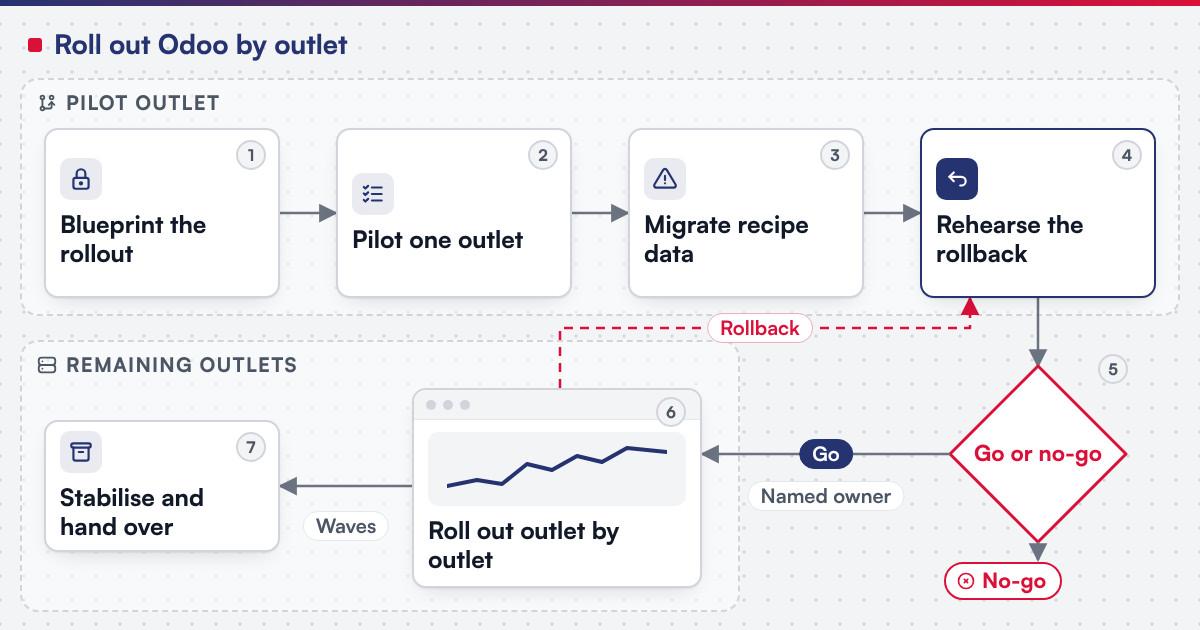 (opens the full-size diagram in a new tab)
Worked scenario: a six-outlet fast-casual chain's pilot
A hypothetical fast-casual chain runs six outlets from one central kitchen that preps sauces and dough, with recipes on paper, kitchen tickets shouted from the counter, and perishable stock tracked on handwritten labels. The blueprint stage maps the central kitchen's recipes onto Odoo's bills of materials, and each outlet's till onto Point of Sale with kitchen order printing. The pilot outlet goes live first: its till staff route orders to the kitchen printer for a full trading week while perishable stock migrates onto lots with expiration dates in parallel, and a stock discrepancy on day two is traced to a lot whose removal time was left at a default, fixed before the next outlet is touched. The go or no-go review checks that the pilot outlet's kitchen ticket times hold steady and that its accounting close reconciles under the chain's shared chart of accounts; only then do the remaining five outlets roll out in two scheduled waves.
What has Netbase delivered for food and beverage operations?
Working with a local Odoo implementation partner, Netbase has consulted on and customised Odoo in Vietnam for a food and beverage franchise chain, among other clients that are not named; the Odoo implementations record is the published summary of that work. Netbase's ERP consultancy and development experience also covers cloud ERP platform development, and the modules built include finance and accounting, inventory, sales orders, HR and recruiting, CRM and project planning.
Plan the next step for your project
Where does AI fit in a food and beverage chain's Odoo rollout?
The categories that pay off first are demand forecasting for perishable items from the sales and stock history Point of Sale and Inventory already hold, flagging a kitchen ticket time that is drifting for a supervisor to review, and drafting a purchase order for a buyer to approve rather than placing it automatically. None of it replaces the recipe, kitchen-routing or expiration logic Odoo already owns; it reads from records that are more trustworthy once every outlet reports into one system instead of a spreadsheet each. Legacy application modernization is the usual route when an AI feature is added to a rollout already running rather than a new implementation.
What should you check before committing to the stack?
Odoo's own Point of Sale restaurant documentation describes "managing restaurant floors and tables, and monitoring table status in real time," with orders sent to a kitchen or bar printer once one is connected in the Preparation settings, routed by the product categories assigned to it. Its bill of materials documentation states that a BoM "documents specific components, along with their respective quantities, that are needed to produce or repair a product," and a kit-type BoM behaves differently on a sale: "when a kit is sold as a product, it appears as a single line item on the quotation and sales order," while "on delivery orders, each component of the kit is listed." Its expiration dates documentation tracks an expiration time, a best-before time, a removal time and an alert time for a lot, and states that to sell perishable products with expiration dates, the removal strategy of the location they are stored in "must be set to FEFO." Its multi-company documentation states that companies "can be configured under one database," allowing "some data to be shared among companies while maintaining some separation," and its accounting documentation adds that each company has its own chart of accounts, while for branches "the parent company's chart of accounts, main currency, and taxes apply to all branches" and the parent "can access all reports, invoices, bills, etc., from its branches." Confirm before scoping a build:
- Which outlets need kitchen-printer routing by product category, since the documentation routes tickets by the categories assigned to a printer.
- Which prepared items are kit-type bills of materials, since a kit still shows its components on a delivery order even though it sells as one line.
- Which perishable items need a removal strategy set to FEFO, since that setting, not the expiration dates alone, is what picks the soonest-expiring lot first.
- Whether franchisees run as branches or as separate companies, since the parent company's chart of accounts and taxes apply to all branches, while each separate company has its own chart of accounts.
What goes wrong in a food and beverage chain's Odoo rollout?
- Rolling out every outlet at once. Skipping the pilot outlet means the first real mistake is made at full scale instead of on one site.
- Leaving a lot's removal time at its default. An expiration policy copied without review repeats the stock-out or waste the new system was meant to fix.
- Treating franchisee reporting as an afterthought. Deciding late whether outlets share one company or run as separate ones is expensive to reverse once accounting entries exist.
- No rehearsed rollback. An outlet that has never tested going back to its legacy process discovers the rollback does not actually work during a live cutover.
Which questions should you ask an Odoo implementation supplier?
- Which parts of this rollout are standard configuration, and which require a custom module for a workflow Odoo's modules do not already model?
- How is the pilot outlet chosen, and what does the go or no-go review check before the next wave is approved?
- How is scope fixed? Most Netbase projects are agreed as fixed-scope contracts after discovery, with milestone-based arrangements also available.
- What does the delivery plan look like? Netbase's delivery lifecycle: discovery and strategic alignment; team assembly and architecture planning; agile execution with outcome-based milestones; modular components; training and rollout; ongoing support. For this rollout, discovery closes once the pilot outlet's recipes, kitchen routing and perishable-stock policy are signed off.
How this guide is sourced and where it stops
The Odoo facts are read from the documentation for Odoo 18.0 on the dates cited. The rollout sequence and the operation table are editorial planning guidance, and the six-outlet scenario above is hypothetical.
Common questions
Yes, that is the pilot-outlet pattern this guide recommends: one outlet runs fully on Odoo while the rest continue as before, until the go or no-go review clears the next wave.
Each prepared item keeps its own recipe as a bill of materials; what should be shared across outlets is the configuration pattern, the kitchen-routing set-up and the perishable-stock policy, so the next outlet repeats a proven setup.
A manufacturing order on the central kitchen's own bills of materials supplies finished or semi-finished items to each outlet's stock, rather than every outlet preparing everything from scratch.
Either is possible: outlets reporting as one business can run as branches under the parent company's chart of accounts and taxes, while a franchisee with its own legal entity is usually set up as its own company, with its own chart of accounts, in the same database.
Move what the new process needs: current recipes, open purchase orders and active supplier records usually move, while closed historical transactions can stay in an archive.
Plan your outlet-by-outlet Odoo rollout
Bring your outlet count, current recipes and kitchen workflow, and the franchisee reporting you already run to a scoping session, and a person will map them onto the sequence above. Legacy application modernization is the route when an existing outlet system needs assessing first.
OutsourcingVN is Netbase's own outsourcing-services platform. Submit a project with your outlet count and current systems, and a person will reply with a sequence like the one above.
Work behind this guide

This record is published because partner-assisted delivery is worth showing plainly.
Keep ReadingRelated services and solutions
 Legacy application modernization, one bounded capability at a time
The code is assessed first, then one bounded capability moves at a time, with a way back.
Learn More