

Magento implementation for fashion retailers: planning the first release
A Magento implementation for a fashion retailer works when size and colour sell as configurable products with real swatches, stock is visible across every shop and warehouse, and the catalogue supports a second brand, storefront or language without re-platforming. Scope the catalogue and stock model first, prove it on one storefront, then add lookbooks, a companion app and further storefronts.
Submit a project See the Netztech migration recordReviewed by Huy Nguyen (David), CEO · Updated 19 Oct 2026 · 11 min read

OutsourcingVN is operated by Netbase JSC. This guide plans the implementation once Magento has already been chosen; whether it fits your catalogue at all is the prior question, answered on the Magento platform page.
Contents
- What does a fashion retailer's Magento catalogue need to cover?
- How does Magento model a fashion catalogue's needs?
- How should the first release be built?
- Worked scenario: a two-brand fashion retailer's first release
- What has Netbase built on Magento for fashion and retail?
- Where does AI fit in a fashion Magento implementation?
- What should you check before committing to the stack?
- What goes wrong in a fashion Magento implementation?
- Which questions should you ask an implementation partner?
- How this guide is sourced and where it stops
- Common questions
- Plan your fashion store's first release
What does a fashion retailer's Magento catalogue need to cover?
Deciding whether Magento is the right platform at all, against WooCommerce or a custom build, is covered on the Magento vs WooCommerce guide; this page starts once Magento is chosen and plans the fashion-specific build. A fashion catalogue adds demands a generic storefront does not: size and colour sold as real, trackable variants rather than a text note; a size guide the shopper actually reads before checkout; lookbook and merchandising content that still links back to buyable products; stock that is accurate across more than one shop or warehouse; and, often, a companion mobile app once the storefront itself is proven. Retail, commerce and marketplaces covers the wider sector context this implementation sits inside.
How does Magento model a fashion catalogue's needs?
| Fashion catalogue need | Magento mechanism | What it replaces |
|---|---|---|
| Size and colour sold as real variants | A configurable product with a child simple product per variant, each with its own SKU | One SKU with a free-text "available sizes" note |
| Colour shown visually | The Visual Swatch attribute input type | A plain dropdown of colour names |
| Size shown as a quick key | The Text Swatch attribute input type | A dropdown with no visual size reference |
| Stock across shops and warehouses | Inventory Management sources, each a physical location, aggregated into a stock | One shared warehouse quantity for every channel |
| A second brand, storefront or language | Websites, stores and store views in one back office | A separate Magento install per brand or market |
| Lookbook and merchandising content | Storefront CMS content and category merchandising linked back to the catalogue | A static lookbook page with no path to a product |
Neither swatch type is fashion-specific on its own; the pattern above is what turns Magento's general catalogue model into a fashion one.
How should the first release be built?
-
Blueprint the attribute set and store structure
Decide which attributes (size, colour, fit) are configurable, and which websites, stores or store views the first release actually needs.
-
Build configurable products and swatches
Configure colour as a visual swatch and size as a text swatch, with each variant tracked as its own simple product and SKU.
-
Add size guidance and scope the returns workflow
Attach size-guide content to the product page, and scope the returns and exchange workflow against the order data the storefront already exposes.
-
Wire stock across every shop and warehouse
Create a source for each physical location and let a stock aggregate availability per sales channel, so one storefront never oversells another's inventory.
-
Configure the second storefront, brand or language
Add the website, store or store view a second brand or market needs, sharing the catalogue where sharing makes sense and splitting it where it does not.
-
Scope the companion app and integrations
Decide which catalogue, stock and order endpoints a companion shopping app, a PIM or a 3PL integration will call, before that build starts on its own track.
-
Rehearse the cutover and launch the first storefront
Load real catalogue and stock data, rehearse checkout and fulfilment end to end, then launch one storefront before the rest follow.
Worked scenario: a two-brand fashion retailer's first release
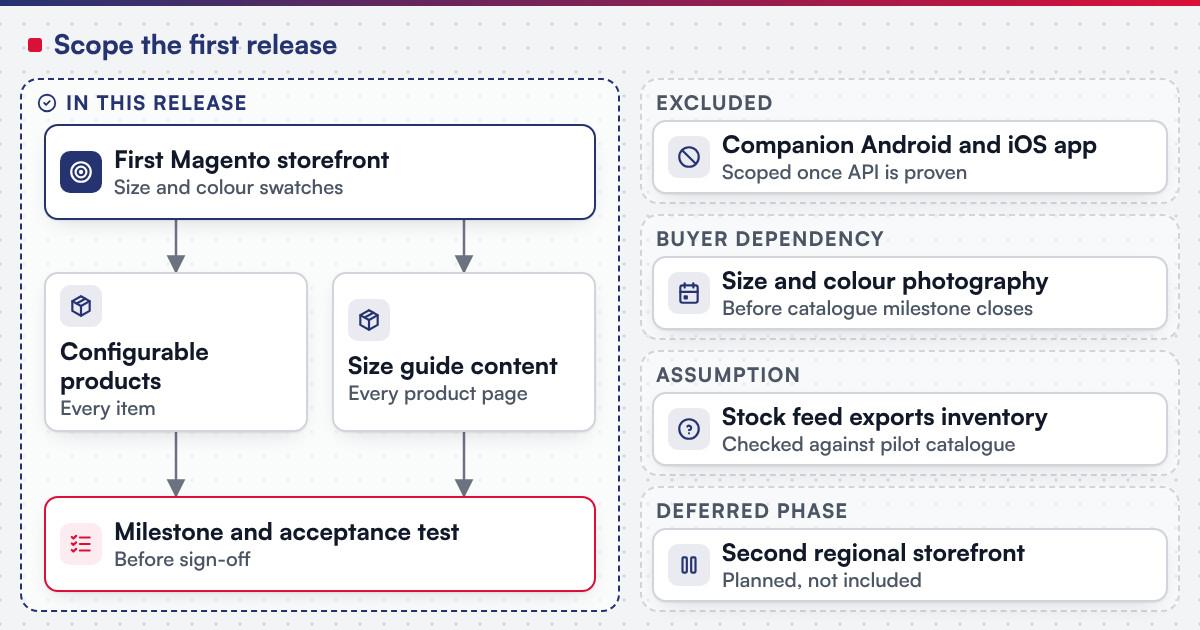
A hypothetical two-brand fashion retailer plans a single Magento storefront before it adds a companion shopping app or a second regional storefront.
- In this release. The first storefront ships with configurable products carrying size and colour swatches on every item and size-guide content on every product page, each tied to a milestone and an acceptance test before sign-off.
- Excluded. The companion Android and iOS app is excluded from release one; it is scoped once the storefront catalogue and its API are proven.
- Buyer dependency. Photography for every size and colour combination is a buyer dependency, supplied before the catalogue milestone closes.
- Assumption. The retailer's current stock feed is assumed to export inventory per size and colour variant; the assumption is checked against the pilot catalogue in the first week.
- Deferred phase. A second regional storefront, in a second language, is a deferred phase: planned, not included in release one.
 (opens the full-size diagram in a new tab)
What has Netbase built on Magento for fashion and retail?
Representative Magento work on record includes Magento stores with companion Android and iOS apps for a women's fashion retailer in the Netherlands and an omnichannel fashion retailer in Nigeria. Separately, Netbase built a headless multi-store reward shop platform for a Dubai-based loyalty and rewards technology company: individually branded shops per client programme on Magento 2 Open Source with a Next.js front end, delivered in four phases over 3.5 to 4.5 months, the closest published example of the multi-store pattern a second brand or market needs. On the migration side, for Netztech, Netbase delivered a Magento 1 to Magento 2 migration in 35 working days across 11 extensions; see the Netztech migration record. The anonymised web-to-print stores in four countries record is where this representative Magento evidence is sourced and disclosed.
Plan the next step for your project
Where does AI fit in a fashion Magento implementation?
The categories that pay off first on a fashion catalogue are attribute and size-guide enrichment drafted from supplier spec sheets for a merchandiser to check, a support assistant that answers sizing and returns questions before a human ticket opens, and personalised outfit or lookbook recommendations layered onto merchandising rules the storefront already has. None of it replaces the configurable-product and stock model this guide plans; it reads from a catalogue that is more useful once every variant and every source reports accurately. E-commerce development scopes where an AI feature belongs against where a merchandising rule already does the job.
What should you check before committing to the stack?
Adobe's own documentation states that a configurable product "displays as a single product with dropdown options for variations" and that "each variation is a separate simple product with its own SKU," tracked for inventory independently; shoppers choose a variation through a Visual Swatch or Text Swatch attribute, the input types fashion catalogues use for colour and size. Adobe's documentation on store structure states that "when Adobe Commerce or Magento Open Source is installed, a hierarchy that includes a main website, store, and store view is created," and that a store's primary role is root-category configuration while a store view's primary role is translation and locale, the mechanism behind a second brand or language. Its inventory documentation defines a source as "a physical location where product inventory is managed and shipped for order fulfillment," aggregated into a stock that "maps your sales channels with sources for available inventories." Confirm before scoping a build:
- Which attributes are configurable from day one, since adding a new configurable attribute after launch touches every existing simple product underneath it.
- How many sources the stock model needs, one per shop and warehouse that actually holds inventory, not one per sales channel.
- Whether the storefront should sit behind its own front end, the decision headless vs traditional e-commerce covers once Magento itself is chosen.
- Which Adobe Commerce or Magento Open Source release line is in scope, checked against the current compatibility matrix; Adobe lists 2.4.9 as the latest version as of the access date below, with support running from 2.4.4 through it.
What goes wrong in a fashion Magento implementation?
- Size and colour left as a dropdown note. Without real configurable variants, stock per size and colour cannot be tracked, and the first restock turns into a manual reconciliation.
- The companion app started before the storefront API is stable. An app built against a catalogue and stock model still changing underneath it has to be rebuilt, not patched.
- Every storefront and language launched at once. Skipping a proven first storefront means the first real mistake happens at full scale.
- Stock sources never reconciled before go-live. A source per warehouse that nobody checked against a physical count overstates or understates availability from day one.
Which questions should you ask an implementation partner?
- Which attributes are configurable now, and which could be added later without disturbing the existing catalogue?
- How is stock reconciled across every shop and warehouse once sources are live, and who signs off the first count?
- Who owns the storefront API a companion app will call, and is that app scoped as mobile app development or as part of a mobile commerce app?
- How is scope fixed? Most Netbase projects are agreed as fixed-scope contracts after discovery, with milestone-based arrangements also available.
- If a live store is ever compromised, what is the recovery plan? Netbase's scoped three-phase recovery for a compromised Magento store, investigation, cleanup and hardening, typically runs 6 to 13 days depending on the damage, with no guarantee of full recovery implied; see the Magento recovery and hardening record.
How this guide is sourced and where it stops
The Magento and Adobe Commerce facts are read from Adobe's own documentation on the dates cited. Netbase's evidence covers representative Magento fashion-retail work, a multi-store headless build, a named migration and a scoped recovery pattern; the steps above are editorial guidance for a fashion implementation, not a duration claim for any one project. An existing storefront nearing the end of its useful life is better served by the e-commerce platform modernization checklist than by a fresh implementation plan.
Common questions
Yes. A configurable product groups variant simple products behind one listing, with a visual swatch for colour and a text swatch for size.
Yes. Each physical location becomes a source, and a stock aggregates availability per sales channel from its assigned sources.
It depends on whether B2B company accounts and quotes, content staging and managed cloud hosting are needed; the core catalogue, swatch and inventory model this guide plans is shared by both editions.
Yes, and it usually should: scoping the app once the catalogue and stock API are stable avoids rebuilding it against a moving target.
Representative work on record includes Magento stores with companion Android and iOS apps for a women's fashion retailer in the Netherlands and an omnichannel fashion retailer in Nigeria; see the web-to-print stores in four countries record.
The e-commerce platform modernization checklist covers that decision for an existing store on any platform.
Plan your fashion store's first release
Bring your attribute set, your shop and warehouse count, and whether a companion app is in scope for release one or a later phase, and a person will map them onto the sequence above. E-commerce development scopes the storefront itself, and mobile app development scopes the companion app once the storefront API is stable.
OutsourcingVN is Netbase's own outsourcing-services platform. Submit a project with your catalogue and stock model, and a person will reply with the fit.
Work behind this guide

This page describes the work, not the incident.
Keep Reading
What this record reports instead is a duration and a scope, both attested.
Keep Reading
The stores run on WooCommerce and WordPress, with a design tool in Angular JS or Vue.js and PDF generation for production files.
Keep ReadingRelated services and solutions
 E-commerce development, built, extended or replatformed as a project
A store built, extended or replatformed on Magento, WooCommerce or headless, as scoped milestones.
Learn More