

Magento implementation for parts and equipment sellers: planning the first release
A Magento implementation for a parts and equipment seller works when part numbers and compatibility data are searchable, B2B company accounts can quick-order and requisition against their own catalogue and quotes, and stock stays accurate across every warehouse before a companion app or PIM integration is added. Scope the catalogue and B2B model first, then layer the rest.
Submit a project See the Netztech migration recordReviewed by Huy Nguyen (David), CEO · Updated 22 Oct 2026 · 11 min read

OutsourcingVN is operated by Netbase JSC. This guide plans the Magento build for one vertical, a parts and equipment seller's catalogue and B2B rules, once Magento itself is chosen on the Magento platform page; the same pattern for an apparel catalogue is on Magento implementation for fashion retailers.
Contents
- What does a parts and equipment seller's Magento catalogue need to cover?
- How does Magento model a parts catalogue's needs?
- How should the first release be built?
- Worked scenario: a parts and equipment seller's first release
- What has Netbase built on Magento for parts and equipment sellers?
- Where does AI fit in a parts and equipment seller's Magento implementation?
- What should you check before committing to the stack?
- What goes wrong in a parts seller's Magento implementation?
- Which questions should you ask a Magento implementation supplier?
- How this guide is sourced and where it stops
- Common questions
- Plan your parts catalogue's first release
What does a parts and equipment seller's Magento catalogue need to cover?
A parts and equipment catalogue adds demands a generic storefront does not: SKUs carrying attributes a buyer actually searches by, such as a part number or a compatibility code; a B2B company account that reorders against its own catalogue rather than the public listing; a quick order screen and a requisition list for a buyer who already knows what to reorder; a negotiated quote for a request the catalogue's standard terms do not cover; and stock that is accurate across more than one warehouse before a companion app or a PIM feed is added. The generic account, approval and reorder layer a B2B buyer needs is planned on B2B ordering portals; this page plans the Magento-specific build of that layer for one vertical. Manufacturing and field service covers the wider sector context a parts and equipment seller often sits inside.
How does Magento model a parts catalogue's needs?
| Parts catalogue need | Magento mechanism | What it replaces |
|---|---|---|
| Search by part number or compatibility code | A product attribute with "Use in Search" set to yes | A spec sheet or PDF lookup |
| A company account with its own catalogue and pricing | Adobe Commerce B2B company account with a shared catalogue | A single public listing for every buyer |
| Reordering a known part fast | Adobe Commerce B2B Quick Order and Requisition Lists | Rebuilding a cart from scratch each time |
| A request the standard listing does not cover | Adobe Commerce B2B Negotiable Quotes | An email or phone quote with no record |
| Stock across more than one warehouse | Inventory Management sources, aggregated into a stock | One shared quantity for every channel |
| Compatibility data at catalogue scale | A dedicated attribute set, a PIM feed or an extension | A spreadsheet matched by hand |
This guide plans compatibility data, such as the equipment each part fits, as attribute and feed work, which is why the table routes it to an attribute set, a PIM feed or an extension.
How should the first release be built?
-
Blueprint the attribute set
Decide which attributes carry the part number and compatibility data, and mark the ones a buyer searches by as searchable.
-
Build the catalogue with those attributes populated
, so a part number or compatibility code returns the right SKU from the storefront search box.
-
Configure the B2B company account layer
Decide which company accounts need a shared catalogue, quick order and negotiated quotes, and which can use the public storefront as is.
-
Wire stock across every warehouse
Create a source per physical location and let a stock aggregate availability per channel, so one buyer never oversells another's reserved inventory.
-
Scope the PIM or extension integration for compatibility data
, maintained inside Magento's own attribute set or synced from elsewhere, on its own track.
-
Scope the companion app and ERP integration
, deciding which catalogue, stock and quote endpoints they call, once the storefront's own API is stable.
-
Rehearse the cutover and launch
Load real catalogue, compatibility and stock data, rehearse a company-account order and a quote end to end, then launch.
Worked scenario: a parts and equipment seller's first release
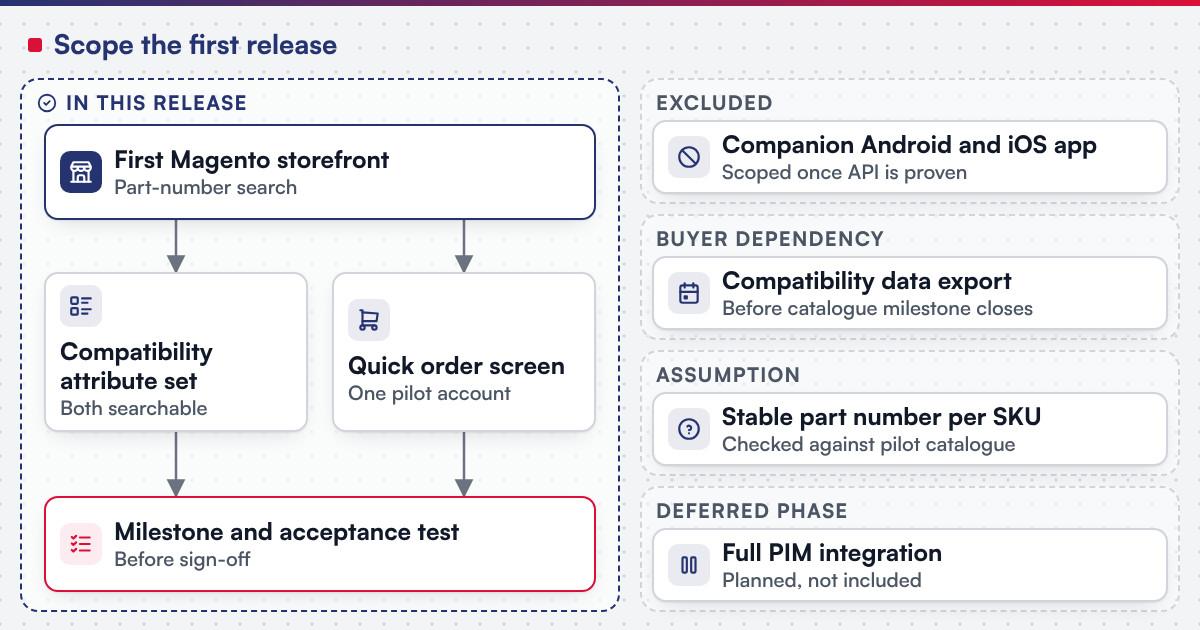
A hypothetical parts and equipment seller plans a single Magento storefront with part-number search and one pilot B2B company account before it adds a companion app or a full PIM integration.
- In this release. The first Magento storefront carries a part-number attribute and a small compatibility attribute set, both searchable, with one pilot company account testing its shared catalogue and a quick order screen, tied to a milestone and an acceptance test before sign-off.
- Excluded. The companion Android and iOS app is excluded from release one; it is scoped once the catalogue and stock API are proven.
- Buyer dependency. A clean compatibility data export, one row per part and the equipment it fits, is supplied before the catalogue milestone closes.
- Assumption. The current ERP or spreadsheet export is assumed to carry a stable part number per SKU; checked against the pilot catalogue in the first week.
- Deferred phase. A full PIM integration keeping compatibility data in step with a separate system of record is planned, not included in release one.
 (opens the full-size diagram in a new tab)
What has Netbase built on Magento for parts and equipment sellers?
Representative Magento work on record includes a Magento store with companion Android and iOS apps for a parts and equipment seller. Separately, for Netztech, Netbase delivered a Magento 1 to Magento 2 Commerce migration in 35 working days, including migrating 11 extensions; see the Netztech migration record. Separately again, for an existing client store, Netbase scoped a three-phase recovery of a compromised Magento site, typically 6 to 13 days in total depending on the damage; see the Magento recovery and hardening record. On the ERP side, Netbase's own ERP consultancy and development experience covers e-commerce integration with ERP by API synchronisation of product catalogues, inventory, orders and customer data, for clients that are not named; the Magento and Odoo integration guide and e-commerce and ERP integration cover that sync layer further.
Plan the next step for your project
Where does AI fit in a parts and equipment seller's Magento implementation?
The categories that pay off first on a parts catalogue are compatibility and attribute enrichment drafted from supplier spec sheets for a merchandiser to check before it publishes, search relevance tuning so a part number or compatibility code surfaces the right SKU even with a typo, and a support assistant that answers fitment and stock questions before a human ticket opens. None of it replaces the attribute and stock model this guide plans. E-commerce development scopes where an AI feature belongs against where a merchandising rule already does the job.
What should you check before committing to the stack?
Adobe's own B2B documentation describes the Company account as "a key entity within B2B on which all other features are in some way dependent," and states that support for Shared Catalogs and for Negotiable Quotes is "available only for Commerce stores configured to support Company accounts," and it presents quick order and requisition lists as part of the same B2B extension installed in an Adobe Commerce store, so a company account, a shared catalogue, quick order, requisition lists and negotiated quotes are Adobe Commerce B2B features rather than Magento Open Source ones. Its product attribute documentation states "if the attribute is to be available for search, set Use in Search to Yes," the property behind a part-number search. Its inventory documentation defines a source as "a physical location where product inventory is managed and shipped for order fulfillment," aggregated into a stock, the mechanism behind stock across more than one warehouse. Page Builder does not separate the editions the way the B2B features above do: Adobe's Magento Open Source 2.4.3 release notes record it as bundled into Open Source as "the default content editing tool for Adobe Commerce 2.4.3 and Magento Open Source 2.4.3" alike. Confirm before scoping a build:
- Which attributes carry the part number and compatibility data, and which need "Use in Search" turned on.
- Whether the B2B features your buyers need require Adobe Commerce, since company accounts, shared catalogues, quick order, requisition lists and negotiated quotes sit in that edition, not in Open Source.
- How many sources the stock model needs, one per warehouse that actually holds inventory.
- Which Adobe Commerce or Magento Open Source release line is in scope, before extensions and a PIM integration are scoped against it.
What goes wrong in a parts seller's Magento implementation?
- Compatibility data left in a spreadsheet. Without a searchable attribute or a PIM feed behind it, a buyer who knows the part number still cannot find it from the search box.
- B2B features scoped before the edition decision. Assuming company accounts, shared catalogues, quick order and negotiated quotes ship with Open Source turns a scoping call into a rebuild.
- The companion app started before the catalogue API is stable. An app built against a model still changing underneath it has to be rebuilt, not patched.
Which questions should you ask a Magento implementation supplier?
- Which attributes carry the part number and compatibility data, and which are marked searchable?
- Does our buyer base need Adobe Commerce's B2B features, or does Open Source cover the account model we run?
- Who owns the storefront API a companion app or a PIM feed will call, and is that app scoped as mobile app development once the catalogue is stable?
- How is scope fixed? Most Netbase projects are agreed as fixed-scope contracts after discovery, with milestone-based arrangements also available.
How this guide is sourced and where it stops
The Magento and Adobe Commerce facts are read from Adobe's own documentation on the dates cited. Netbase's evidence covers a representative parts and equipment seller build, a named migration, a scoped recovery pattern and ERP integration experience; the build sequence and the worked scenario are editorial planning guidance.
Common questions
Not automatically. A part-number or compatibility attribute needs its "Use in Search" property turned on before it joins the storefront's keyword search.
If company accounts, shared catalogues, quick order, requisition lists or negotiated quotes are part of the plan, yes: those are Adobe Commerce B2B features, not Magento Open Source.
Plan it as catalogue data: compatibility is usually modelled as a dedicated attribute set, kept in step with a PIM feed, or handled by an extension layered onto the catalogue.
Yes. Each physical location becomes a source, and a stock aggregates availability per sales channel from its assigned sources.
Yes. Waiting until the part-number search and the B2B account layer are proven means the app's first build targets an API contract that is no longer in motion.
The Netztech migration record and the Magento recovery and hardening record are the closest published Magento records; the chapter on what Netbase has built on Magento sets them beside the parts and equipment seller store.
Plan your parts catalogue's first release
Bring your attribute set, your compatibility data source, your warehouse count and which B2B features your buyers actually need, and a person will map them onto the sequence above. E-commerce development scopes the storefront itself, and e-commerce and ERP integration covers the sync layer once a PIM or ERP sits behind the catalogue.
OutsourcingVN is Netbase's own outsourcing-services platform. Submit a project with your catalogue, compatibility data and B2B requirements, and a person will reply with the fit.
Work behind this guide

This page describes the work, not the incident.
Keep Reading
What this record reports instead is a duration and a scope, both attested.
Keep ReadingRelated services and solutions
 E-commerce development, built, extended or replatformed as a project
A store built, extended or replatformed on Magento, WooCommerce or headless, as scoped milestones.
Learn More