

Local business directory launch: seed, verify, then expand one market at a time
A local business directory launches well when it opens in one market with enough verified listings to be useful, a clear way for owners to claim and correct them, and category and location pages that only go live once they have real entries. Plan listing sources, verification, page structure and rollout before building features.
Submit a project See custom product engineeringReviewed by Huy Nguyen (David), CEO · Updated 28 Sep 2026 · 9 min read

OutsourcingVN is operated by Netbase JSC, which builds directory and marketplace platforms and would like to build yours, so read this as a supplier's launch plan. It works with any team.
Contents
- What does a directory need on the day it opens?
- Where do the first listings come from?
- How should claiming and verification work?
- Which pages should be public at launch?
- What is a sensible launch sequence?
- Worked scenario: opening a directory in one state
- What has Netbase built for directories and marketplaces?
- Which questions should you ask a supplier?
- What goes wrong at launch?
- Common questions
- Plan your first market with us
What does a directory need on the day it opens?
Visitors judge a directory in seconds: search for a plumber in their district and see whether the answers are real, current and reachable. Three things decide that first impression, and none of them is a feature list.
- Density in one place. Enough listings in the launch city and categories that most searches return several credible results.
- Trust signals. A visible difference between a listing the directory has checked and one it has only imported.
- A working contact path. Call, message or directions that reach the business today.
The business directory platforms page scopes the platform itself: actors, workflow, modules and data. This guide is the launch plan that sits on top of it.
Where do the first listings come from?
| Source | Speed to volume | Data quality | Owner engagement | Watch out for |
|---|---|---|---|---|
| Field capture by agents | Slow | High, with photos and location | High, owner met in person | Cost per listing and agent consistency |
| Owner self-registration | Slow at first | Mixed, depends on the form | High | Empty categories until word spreads |
| Partner lists (associations, chambers, councils) | Fast | Varies by partner | Low until claimed | Licence to reuse the data and how often it is refreshed |
| Licensed data providers | Fast | Varies; often stale contact details | Low | Terms of reuse and duplicate records |
| Scraping public sources | Fast | Low and legally uncertain | None | Terms of service, privacy law and reputational risk |
Most launches combine two: a partner or licensed list for breadth, and field capture or owner registration for the listings that carry a verified badge. Treat imported listings as unclaimed until an owner or agent confirms them.
How should claiming and verification work?
Verification is the product. A directory that lets anyone publish anything becomes a list of stale numbers within months.
- Claim. The owner proves control of the business phone or email, usually with a one-time password, and takes over the listing.
- Verify. The directory confirms the business exists at the stated place: a field visit with a geotagged photo, a document check, or a call to a published number.
- Badge. A verified listing shows a badge with a date, so visitors know how recent the check is.
- Expire. Badges lapse after a fixed period unless renewed, which keeps the trust signal honest.
- Challenge. Visitors can report a closed business or wrong details, and reports enter a review queue with an audit trail.
Keep the verification rules short, public and consistently applied. The badge only means something if every badge meant the same check.
Which pages should be public at launch?
A directory generates pages from combinations of category and location: "electricians in Ikeja", "dentists in Lekki". Those pages are how most visitors arrive from search, and they are also where directories go wrong.
- Publish a category-location page only when it has real listings. Google's spam policies describe doorway pages and scaled low-value content; thousands of empty "X in Y" pages are exactly that pattern.
- Give each page something beyond the list. Filters, opening hours, a short note on what verified means, recent reviews.
- Mark up listings with structured data where it is accurate. Google documents LocalBusiness structured data for name, address, hours and contact details; only mark up what the listing actually holds.
- Render server-side and keep pages light. Most visitors arrive on a phone, often on a slow connection.
Property and trade listings carry extra questions about licensing and project records; the real estate and construction page covers the workflows a directory in that sector would touch.
What is a sensible launch sequence?
-
Choose the first market
One city or state, and a short list of categories where search demand and supply both exist.
-
Agree the verification rule and badge period
before any listing is captured.
-
Seed listings
from a partner list and field capture until each launch category has enough entries to be useful.
-
Open owner claims
and run a short campaign to the imported businesses.
-
Publish category-location pages
as each one passes its minimum listing count.
-
Switch on paid features
such as featured listings or badge subscriptions only after visitors are arriving, so paying owners get something.
-
Review and expand
Check search coverage, claim rate and report volume, then add the next city or category using the same rules.
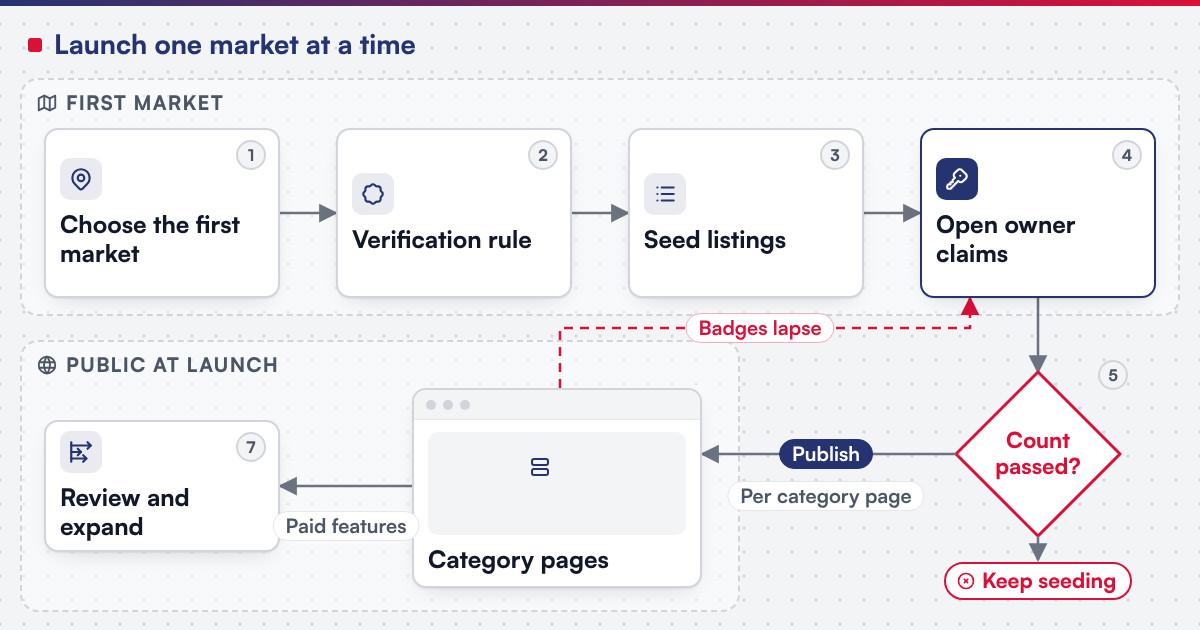 (opens the full-size diagram in a new tab)
Worked scenario: opening a directory in one state
A founder plans a directory of trades and home services for one state, with a national ambition.
- Weeks 1-2. Launch categories are fixed at twelve, from electricians to movers. The verification rule is a field visit with a geotagged photo, valid for twelve months.
- Weeks 3-8. A trade association list supplies unclaimed listings. Six field agents verify listings in the two largest cities, capturing photos offline and syncing when they reach coverage.
- Week 9. Category-location pages go live only for combinations with enough verified entries; the rest stay unpublished.
- Week 10. Owners of imported listings receive a claim message. A head-office queue reviews agent submissions and visitor reports.
- Week 12. Featured listings open for paying owners. The team reviews which searches return nothing and plans the next city.
The numbers here are illustrative. The pattern is density before breadth, and a badge that means one thing.
What has Netbase built for directories and marketplaces?
The closest published record is the multi-state business directory. For Dey Page, Netbase built a multi-state business directory in Nigeria launching in one state and designed to scale to all 36: a server-rendered, mobile-first web directory with state, city and category pages, search filters, reviews and click-to-chat messaging; phone one-time-password accounts; a location-confirmed badge verified in the field with geotagged photos, identity capture, offline sync, a head-office review queue, 12-month expiry, complaint automation and an audit trail; five administrator roles with per-state dashboards; featured-listing and badge subscriptions through two payment providers; business messaging with SMS fallback; video upload with an optimiser and photo watermarking; and a cross-platform mobile app with consumer and business-owner modes, push, deep links and in-app browser checkout, on a 12-week web and mobile plan. The record describes built scope and claims no launch or user figures.
Adjacent marketplace work shows the vendor side. For RB Marketplace, Netbase built an English-first multi-vendor marketplace for West Africa on Laravel, with vendor registration and administrator approval, store profiles, order fulfilment, commission and payout requests, a customer REST API and 90 days of post-launch support; the multi-vendor marketplace record lists the full scope. A directory that later adds bookings or orders inherits many of those workflows. For delivery to buyers in that region, see the Nigeria software delivery guide.
Which questions should you ask a supplier?
- How will listings be verified, and what does the badge mean? Expect a written rule, not a feature name.
- Can field capture work offline? In many first markets, connectivity is patchy where agents work.
- How are empty category-location pages kept out of search? A threshold rule is the expected answer.
- How do owners claim a listing, and how are disputes resolved? Look for a review queue with an audit trail.
- Which roles does the admin need? Per-region administrators and reviewers are common once more than one state is live.
- Which payment providers work in the launch market? Local providers often matter more than global ones.
- What does the mobile app add over the mobile web? Push and owner tools are good reasons; duplicating the web is not.
What goes wrong at launch?
- Breadth before density. Signal: every city is live and every search returns one listing. Owner: the founder, who narrows to one market.
- Imported data presented as verified. Signal: visitors call closed businesses. Owner: the operations lead, who keeps imported listings unbadged.
- Thousands of empty pages. Signal: search engines index "X in Y" pages with no entries. Owner: the product owner, who sets a publication threshold.
- Paid features too early. Signal: owners pay for visibility nobody sees. Owner: the commercial lead, who waits for traffic.
- No complaint path. Signal: wrong details persist for months. Owner: the operations lead, who staffs the review queue.
Plan the next step for your project
Common questions
Enough that most searches in the launch categories return several credible results. Set the threshold per category and location rather than as one national number.
Usually the mobile web comes first, because most visitors arrive from search. An app earns its place for repeat users and business owners who manage listings, messages and subscriptions.
Only with a licence that allows it. Copied listings are often stale and create legal and reputational risk.
Common models are featured listings, verification or badge subscriptions, lead fees and advertising. Choose one that rewards accurate listings rather than volume.
It depends on scope. The Dey Page directory was planned over 12 weeks for web and mobile; a smaller web-only first release can be shorter.
Plan your first market with us
Bring the market, the launch categories and your verification idea. Custom product engineering is the delivery route for the platform. OutsourcingVN is Netbase's own outsourcing-services platform. Submit a project, and a person will reply with a launch scope and the questions to settle first.
Work behind this guide

No launch is claimed and no user number is published.
Keep Reading
For RB Marketplace, Netbase built an English-first multi-vendor marketplace for West Africa on Laravel, then built the customer shopping app on that marketplace's own API.
Keep ReadingRelated services and solutions
 Custom product engineering for a bounded release outcome
One defined release of your product, built to named outcomes and handed over with acceptance evidence.
Learn More