

Building an AI transformation roadmap your leadership team will actually run
An AI transformation roadmap is a leadership-owned portfolio, not one pilot: a shortlist of candidate use cases scored together, a data-readiness check before any commitment, governance settled before a build starts, a sequence of phases with a named owner each, and the in-house capability the business keeps once the first phase ships.
Submit a project Talk to an AI transformation advisorReviewed by Huy Nguyen (David), CEO · Updated 4 Oct 2026 · 9 min read

OutsourcingVN is operated by Netbase JSC, which combines new AI capability — models, agents, retrieval and evaluation — into delivery rather than selling one fixed tool. This guide sets out a method a leadership team can run itself, with Netbase delivering phases of it, advising on it, or both.
Contents
- Who owns which part of the roadmap?
- How do you build the roadmap?
- Where to go for depth on one step
- Worked scenario: a logistics company's first roadmap cycle
- What governance and security does the roadmap need settled?
- What goes wrong with AI transformation roadmaps?
- How this roadmap method is sourced and where it stops
- Common questions
- Build the roadmap before the first build
Who owns which part of the roadmap?
A roadmap fails less often from bad technology choices than from nobody owning a decision. Split ownership in writing before scoring the first candidate.
| Decision | Leadership team owns | Delivery partner or advisor owns |
|---|---|---|
| Use-case portfolio | Naming candidates and their business value | Scoring technical feasibility of each one |
| Data readiness | Granting access and naming data owners | Assessing quality, access and integration gaps |
| Governance | Approving ownership, audit trail and exit rules | Proposing the guardrails to approve |
| Sequencing | Approving or deferring each candidate at the gate | Recommending an order and a realistic pace |
| Capability building | Committing engineers' time to the pilot | Running the coached pilot and the review gates |
| Measures | Deciding what "working" means for the business | Reporting the measures each review period |
Where the leadership team has no standing seat to hold this split, fractional CTO and AI transformation advisory provides an AI transformation lead on a monthly retainer, with written objectives and a handover to a permanent hire; the fractional CTO versus full-time CTO comparison works through whether that seat is the right shape for your stage. Either way, the roadmap sits above any single engagement: engagement models shows how a phase of it becomes a project, a managed-outcome engagement or a specialist sprint once it is approved.
How do you build the roadmap?
-
Build the candidate portfolio
List candidate use cases across functions — customer, operations, engineering — each with a named workflow owner and the business value it targets, so the leadership team sees the full inventory before any candidate is favoured.
-
Assess data readiness for each candidate
Check data ownership, quality, access and integration before committing a phase to a candidate; a weak answer here is cheaper to find now than mid-build.
-
Score and shortlist against value and risk
Rank candidates on workflow value and delivery risk together, using the same evidence-based approach as scoring a single process for automation, not on enthusiasm for the newest capability.
-
Settle governance before any build starts
Decide ownership, data boundaries, audit trail, supplier dependency and exit for every shortlisted candidate; a candidate that cannot answer these questions is deferred, not waived through.
-
Approve or defer each candidate at a portfolio gate
The leadership team reviews the scored shortlist together and either approves a candidate into the current sequence or defers it, with the reason recorded against it.
-
Sequence approved work into phases with a named owner
Each approved candidate becomes a phase with a workflow owner, a start date and the measure it must move, redesigning the workflow itself as the phase starts rather than bolting AI onto the old one.
-
Build in-house capability alongside delivery
Pair each phase with the engineering practice change it needs — tool permissions, review gates, evaluation measures — so the capability outlasts any single project and the team is not dependent on one vendor for the next one.
-
Review measures every quarter and resequence
Each quarter the leadership team checks the agreed measures, closes finished phases, and re-scores deferred candidates for the next cycle rather than letting them sit unreviewed.
Netbase delivers remote-first from Hanoi in Agile increments with weekly reviews, using AI-assisted engineering under human review, and the same cadence fits a roadmap's review rhythm: short, written, and checked against the measures agreed at the gate rather than against hours spent.
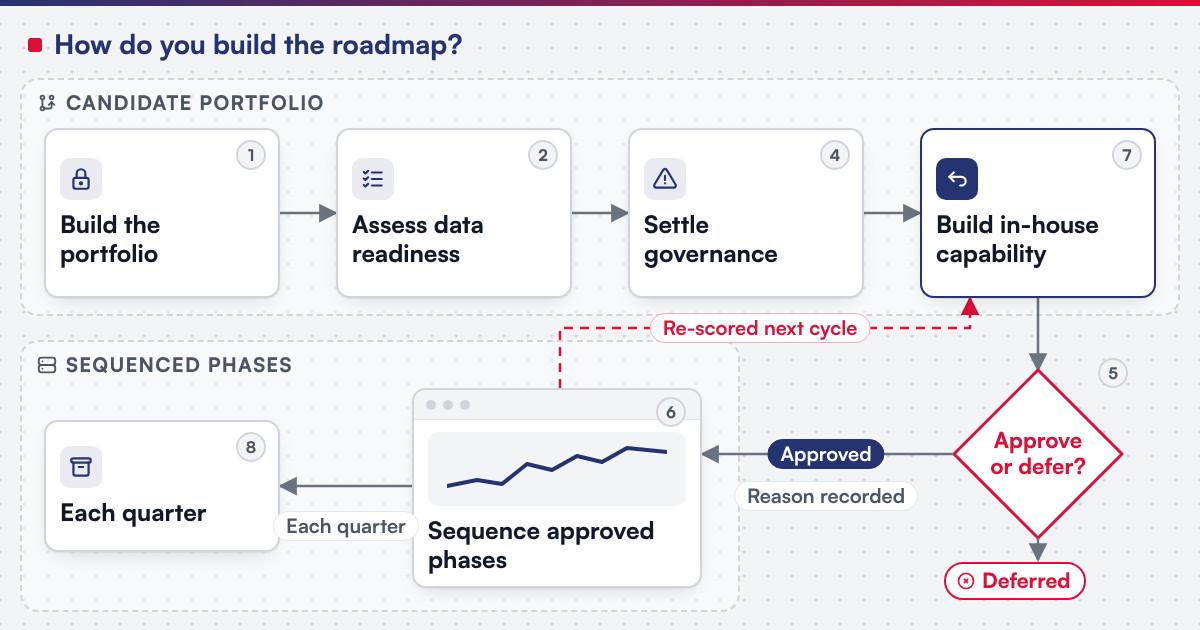 (opens the full-size diagram in a new tab)
Where to go for depth on one step
-
Scoring one candidate workflow for automation
-
The data-readiness checklist
-
The governance questions before approval
-
Redesigning one workflow once a phase starts
-
A short paid decision project for one workflow
-
Coaching an in-house team to build safely
Worked scenario: a logistics company's first roadmap cycle
A mid-sized logistics company has three AI ideas on the table: a customer WhatsApp assistant, a dispatch-scheduling model and a document-processing pipeline for customs paperwork. Nobody has scored them against each other.
The leadership team runs a one-day portfolio session. Each idea gets a data-readiness score, a business-value estimate from the function that owns it, and a risk note from engineering. The WhatsApp assistant scores highest: the data is clean, the function owner is engaged, and a comparable pattern is already proven. The customs pipeline is deferred: the source documents are inconsistent scans, and the data-readiness gap would delay every other phase if tackled first. The dispatch model is approved for the following quarter once its data feed is fixed.
Phase one starts with the WhatsApp assistant, governed by the rules agreed at the gate and reviewed every two weeks against one measure: the share of enquiries resolved without a human handoff. Netbase has delivered anonymised client AI projects including retrieval-based knowledge assistants, document AI and MLOps pipelines, and the WhatsApp AI chatbot and CRM record is the closest published example of this phase's shape: a Business AI chatbot with conversation flows and CRM synchronisation, delivered in milestones. Where a roadmap instead needs one bounded technical decision rather than a full phase, a specialist sprint covers that single mission before it joins the sequence.
What governance and security does the roadmap need settled?
Netbase works with commercial and open-source AI models chosen per project, so model choice stays a sequencing decision rather than a lock-in. Security practices include secure code review and version control, role-based access control, MFA for admin dashboards, contributors under NDA, and NDAs and DPAs on request, and these apply to every phase regardless of which model sits behind it. Netbase applies the ISO/IEC 42001 AI management system framework to its own AI delivery practice; a roadmap that borrows the same discipline — named ownership, a documented review gate, an audit trail — travels well between phases and between vendors.
The closest published example of a standing, multi-year delivery relationship behind a roadmap of this kind is the role Netbase has held since 2020 as offshore development and managing partner on a multi-tenant cloud ERP SaaS platform for a US client (not named); the multi-tenant cloud ERP record documents how later phases built on an agreed foundation rather than restarting each time.
What goes wrong with AI transformation roadmaps?
- One pilot stands in for the whole roadmap. Signal: a single proof of concept gets presented as "our AI strategy." Owner: the leadership team, which should score a portfolio, not one favourite.
- Data readiness is assumed, not checked. Signal: the build stalls in month two on an access request nobody filed. Owner: the data owner named at the portfolio stage, before the gate.
- Governance is written after the build starts. Signal: a security or audit question appears for the first time at launch. Owner: whoever chairs the gate, who should refuse to approve a candidate without it.
- Capability never transfers in-house. Signal: every new phase needs the same external team from scratch. Owner: the sponsoring executive, who should pair each phase with a coached capability-building track.
- The quarterly review never happens. Signal: deferred candidates are forgotten rather than re-scored. Owner: the leadership team, who should calendar the review before the first phase ships.
How this roadmap method is sourced and where it stops
This method draws on Netbase's approved facts about its AI-assisted delivery process, its model-agnostic AI practice, its applied AI management framework and two delivered AI records. It is a method for building and sequencing a portfolio, not a published record of a named client's full roadmap; each engagement's roadmap is scoped and agreed on its own terms.
Plan the next step for your project
Common questions
Enough to compare, usually three to six, scored on the same criteria. A single candidate cannot be prioritised against anything, and a portfolio larger than the team can govern just produces unscored backlog.
Prefer the one with better data readiness. A lower-risk build that ships on schedule teaches the leadership team and the delivery partner more about running the next phase than a higher-value idea that stalls.
No. A lead is most useful when nobody in-house owns the roadmap yet or the mandate spans several functions; once the cadence is running, the leadership team can chair the gate itself with a delivery partner reporting into it.
A deferral keeps the score and the reason on record for the next quarterly review; nothing is discarded. A rejection removes a candidate from future cycles, usually because the underlying workflow changed or disappeared.
The leadership team, not the delivery partner. The partner recommends an order and flags risk; the written objectives and the accept-or-defer call stay with the business that owns the measure.
Build the roadmap before the first build
Bring the candidate list, who owns each workflow, and how soon the first phase needs to show a measure moving. OutsourcingVN is Netbase's own outsourcing-services platform; submit a project and a person will reply with how a first roadmap cycle, or one phase of an existing one, could run.
Work behind this guide

Since 2020, Netbase has worked as offshore development and managing partner on a multi-tenant cloud ERP that a US software company offers as SaaS to small and mid-sized businesses.
Keep Reading
Netbase designed and built an AI chatbot on WhatsApp Business that handles intents and conversation flows and keeps lead and customer data in step with the client's CRM, delivered in milestones from prototype to knowledge transfer.
Keep ReadingRelated services and solutions
 Fractional CTO and AI transformation advisory: leadership without a full-time hire
Technology and AI transformation leadership on a monthly retainer, with a handover to a permanent hire.
Learn More