

Fractional CTO vs full-time CTO: choosing the leadership model that fits your stage
Choose a full-time CTO when you need daily technology leadership managing a growing team, and can commit to a permanent hire. Choose a fractional or interim CTO for a defined mandate over a fixed term with a planned handover. Choose an independent advisory seat when the board needs standing technology judgement without an operating role.
Submit a project Explore fractional CTO advisoryReviewed by Huy Nguyen (David), CEO · Updated 4 Oct 2026 · 9 min read

OutsourcingVN is operated by Netbase JSC, which offers the fractional and interim CTO model among the options compared here, so read this comparison as written by a supplier with a preferred model. The criteria below apply whichever model you choose, and the page says plainly where a full-time hire or an advisory seat fits better.
Contents
- What is the real difference between the three models?
- Which leadership model fits your stage?
- Worked scenario: a Series B company without a CTO between hires
- What should you ask before engaging any model?
- What goes wrong with each model?
- How this comparison is sourced and where it stops
- Common questions
- Choose the model, then the person
What is the real difference between the three models?
The difference is not seniority. It is how much daily management the role carries, how long the commitment runs, and what happens when the role ends.
| Criterion | Full-time CTO | Fractional or interim CTO | Independent advisory seat |
|---|---|---|---|
| Commitment | A permanent hire, full working weeks | Agreed days each month, written objectives | A standing seat with the board or CEO, not daily operations |
| Who directs daily engineering | The CTO, every working day | The advisor sets direction; day-to-day stays with your team | Nobody; delivery stays with your team or another provider |
| Typical term | Open-ended, until the person leaves | 3 to 12 months, reviewed at agreed checkpoints | Open-ended retainer, reviewed periodically |
| Handover built in | Only on departure or succession planning | From day one, to a permanent hire | Not applicable; the seat does not run delivery |
| Best early use | Headcount and roadmap already exist | A gap between hires, or a named mandate such as an AI adoption plan | A board or CEO needs judgement without adding an operating role |
None of these three replaces buying delivery capacity itself. Managed outcomes and the project outsourcing versus staff augmentation comparison cover how the build gets done once direction is set, and engagement models compares every model Netbase offers side by side.
Most Netbase projects are agreed as fixed-scope contracts after discovery; milestone-based arrangements are also available. Netbase also offers dedicated development teams, on-demand support and fully managed delivery as secondary options. Netbase provides fractional or interim CTO, CIO and Chief Digital or Transformation Officer services, including an AI transformation lead, and independent technology advisors who sit with a client's executive team, advisory board or board of directors, structured as a monthly retainer of agreed days over a 3 to 12 month term, with written objectives and a handover to a permanent hire. Where such an advisor recommends a Netbase delivery team, that interest is disclosed, the client decides, and the advisory role can be contracted separately from any delivery work.
Which leadership model fits your stage?
-
Do you need technology leadership every working day, managing a growing team through its daily decisions?
A full-time CTO fits a company that can commit to a permanent hire and needs continuous, in-person direction.
-
Is the gap a defined mandate — a roadmap, an AI adoption plan, a vendor decision or a turnaround — for a fixed number of months?
A fractional or interim CTO fits: agreed days each month, written objectives, and a handover to a permanent hire built in from the start.
-
Does the board or executive team need standing technology judgement at the table, without taking an operating role?
An independent advisory seat fits, reporting to the board or CEO on a retainer rather than running delivery.
-
Is the need one bounded technical decision rather than an ongoing seat at all?
A specialist sprint with a fixed timebox and exit condition is often cheaper to manage than any standing role.
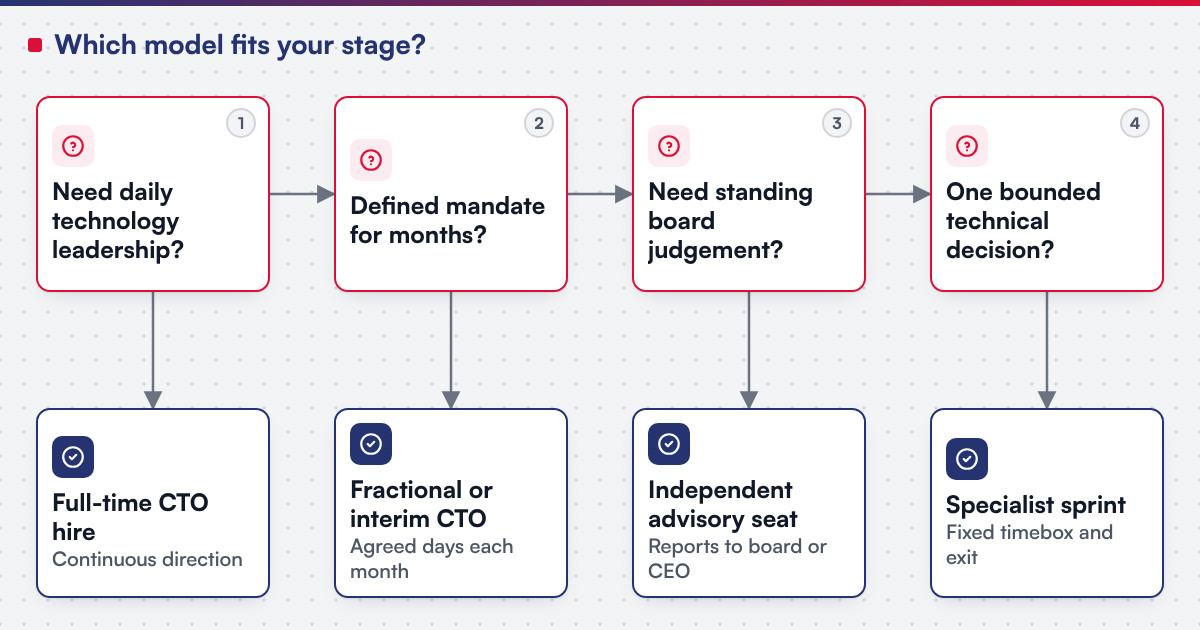 (opens the full-size diagram in a new tab)
Worked scenario: a Series B company without a CTO between hires
A Series B software company loses its CTO and has a board asking hard questions about the AI roadmap. The founder cannot commit to a twelve-month search without someone minding the roadmap meanwhile.
- Question 1. Nobody can manage the engineering team daily yet; a full-time hire is weeks away. A full-time CTO is not available today.
- Question 2. The gap is a defined mandate: assess the architecture, set a first-cut roadmap, and run the search for the permanent hire. A fractional or interim CTO fits.
- Question 3. The board also wants an independent voice at quarterly reviews once the permanent CTO starts; that is a separate, lighter advisory seat, not the interim mandate itself.
- Decision. A four-day-a-month fractional CTO engagement for six months, with the permanent hire's shortlist running in parallel and a written handover at month six.
- Outcome. By month three the roadmap is agreed and two workflow candidates are shortlisted for a deeper decision project; by month six the permanent CTO starts, inherits the written roadmap and the reasoning behind each decision, and the fractional mandate closes on schedule rather than drifting into an unplanned seventh month.
Before committing to either path, a board or investor weighing the decision against the system itself can run a technical due diligence review to separate a leadership gap from an architecture problem. Once the interim mandate sets direction, the AI transformation roadmap is the next document the leadership team builds together, with or without a fractional lead in the room.
The closest published example of Netbase holding a standing leadership relationship with one client over time, rather than a single delivered release, is the role Netbase has held since 2020 as offshore development and managing partner on a multi-tenant cloud ERP SaaS platform for a US client (not named). It is not a published record of a named fractional CTO mandate; each advisory engagement is scoped and agreed on its own terms. The multi-tenant cloud ERP record has the delivery detail.
What should you ask before engaging any model?
-
Accountability
What exactly this person or seat is accountable for this month, written down
-
Cadence
A fixed number of days or hours, agreed before the engagement starts
-
Conflicts
How a recommendation that touches the provider's own delivery teams is disclosed
-
The end
A named handover point, not an open-ended extension
-
Evidence
Specifics you can verify about who else this person or firm has advised
What goes wrong with each model?
- Hiring full-time too early. Signal: the new CTO spends the first quarter deciding what the roadmap even is. Owner: the board, which should scope an interim mandate first when the roadmap itself is the open question.
- The fractional seat becomes permanent by drift. Signal: month twelve arrives with no handover plan and no search underway. Owner: both sides, who should revisit the term at each checkpoint.
- An advisory seat quietly runs delivery. Signal: the advisor starts approving code or managing engineers day to day. Owner: the sponsoring executive, who should scope any resulting delivery as its own engagement.
- Choosing by title, not by commitment. Signal: the debate is "CTO or not" rather than how many days a month and for how long. Owner: the hiring sponsor, who should write the commitment before naming the role.
- No comparison against the full cost of the alternative. Signal: a full-time offer is compared only against a fractional retainer's monthly days, ignoring recruiting time, benefits and ramp-up. Owner: the board, who should total the full first year of either route before deciding.
How this comparison is sourced and where it stops
The comparison draws on Netbase's approved facts about its commercial and leadership-advisory models and one delivered record of a standing client relationship. It does not rank providers, names no advisor, board seat or mandate count, and publishes no fee. The full-time CTO column describes a generic permanent hire, not a Netbase service.
Plan the next step for your project
Common questions
Not necessarily, and this page publishes no rate for either. A fractional CTO's agreed days each month usually cost less in total than a full salary and benefits, but the right comparison is against what the mandate needs, not against headcount alone.
It happens, but the engagement should still plan a handover from day one, because the search should run whether or not the fractional lead ends up taking the role. Treating the fractional mandate as a trial period changes the written objectives it should have.
No. An advisory seat sits with the board or CEO on standing technology judgement; it does not run engineering, hire a team or manage delivery. Many companies keep an advisory seat even after a permanent CTO starts.
The handover plan, written from the start, names what a permanent hire or an existing team needs: the roadmap, the decisions made and why, and any open items. The mandate closes on schedule rather than drifting into an unplanned extension.
The client does. The interest is disclosed at the point of the recommendation, and the advisory retainer can be contracted separately from any delivery work that follows.
Choose the model, then the person
Bring the gap, the audience the role would report to and the term you are considering. OutsourcingVN is Netbase's own outsourcing-services platform; submit a project and a person will reply with whether a fractional CTO, an advisory seat or a full-time search is the better next step.
Work behind this guide

This record covers phase-one scope for agency SMEs; the client and product are not named, and no usage or business result is claimed.
Keep ReadingRelated services and solutions
 Fractional CTO and AI transformation advisory: leadership without a full-time hire
Technology and AI transformation leadership on a monthly retainer, with a handover to a permanent hire.
Learn More