

Loyalty and rewards platforms: plan the redemption, not just the shop
A loyalty reward shop is where members spend points, alone or with cash, on merchandise, gift cards or travel. Planning one means deciding how the shop talks to the points system, who fulfils each reward, what the redemption rules are and whether several programmes share one platform. Settle those four before choosing a storefront.
Submit a project See custom product engineeringReviewed by Huy Nguyen (David), CEO · Updated 18 Oct 2026 · 9 min read

OutsourcingVN is operated by Netbase JSC, which has built a headless multi-store reward shop and would like to build yours, so read this as a supplier's planning guide. The questions apply to any team.
Contents
- What is a reward shop, and how does it differ from a normal store?
- Which platform shape fits your programme?
- How should redemption rules be designed?
- How does fulfilment work across suppliers?
- Worked scenario: a second programme joins the platform
- What has Netbase built in this area?
- Where does loyalty fit in retail and commerce?
- Which questions should you ask a supplier?
- What goes wrong with reward platforms?
- Common questions
- Plan your reward platform with us
What is a reward shop, and how does it differ from a normal store?
A reward shop looks like an online store, but its currency and its customers are different. Members arrive already signed in from a bank, airline, retailer or employer programme. Their balance lives in the programme's points system, not in the shop. Rewards often come from many suppliers, and some, such as travel bookings or digital gift cards, are not parcels at all.
That changes where the hard problems are. Checkout must reserve and deduct points in a system the shop does not own, reverse them when an order fails, and split a basket between points and cash. Order routing must reach the right supplier and chase late fulfilment. The general order-to-cash questions, from capture to reconciliation, are covered by order and payment operations; this guide covers what loyalty adds.
Which platform shape fits your programme?
| Decision | Option A | Option B | Choose A when | Choose B when |
|---|---|---|---|---|
| Number of shops | One shop for one programme | Many branded shops on one platform | You run a single programme | You serve several client programmes or brands |
| Front end | Store theme on the commerce platform | Headless front end over commerce APIs | Branding needs are modest | Each programme needs its own look, app components or channels |
| Payment model | Points only | Points plus cash | Every reward is redeemed for points alone | Members top up expensive rewards with a card |
| Catalogue | Own stock | Multi-vendor and digital suppliers | You hold inventory | Rewards come from partners, gift card and travel providers |
| Points source | Points held in the shop | Points held in external middleware | The shop is the programme | A bank, airline or retailer already runs the ledger |
| Hosting | Cloud | On-premise or client cloud | No residency constraint | Data or security rules require the client's environment |
Headless commerce, with a separate front end calling commerce APIs, is a common way to serve many branded shops from one catalogue and order engine. Adobe documents GraphQL APIs for Magento Open Source and Adobe Commerce storefronts, which is one route to that design.
How should redemption rules be designed?
Write redemption rules as a specification that the finance and programme teams sign, because every rule becomes a test.
- Conversion. How many points equal one unit of currency, per programme, and who may change it.
- Split payment. The minimum points share, and whether cash is ever allowed alone.
- Reservation and deduction. Points are reserved at checkout and deducted only when payment succeeds; a failed payment releases them.
- Reversal. Cancelled or undelivered rewards return points to the member, with a record the programme can reconcile.
- Eligibility. Tier, region or campaign restrictions on which rewards a member may see.
- Limits and abuse. Caps per member and per day. The OWASP API Security Top 10 2023 lists unrestricted access to sensitive business flows as a risk; automated redemption of scarce rewards is a textbook case.
How does fulfilment work across suppliers?
-
Map each reward type to a fulfilment path
stocked goods, a vendor's own shipping, a digital code, or a booking confirmation.
-
Route orders automatically
to the right vendor as soon as payment and points deduction succeed.
-
Set service levels per vendor
and raise an alert when one is breached, before the member complains.
-
Handle partial failure
One item in a basket fails; decide whether to refund points for that line or cancel the order.
-
Reconcile daily
between the shop's orders, the points ledger and vendor invoices, so the programme's liability stays correct.
-
Report per programme
, so each client sees its own redemptions, costs and open orders from a central administration view.
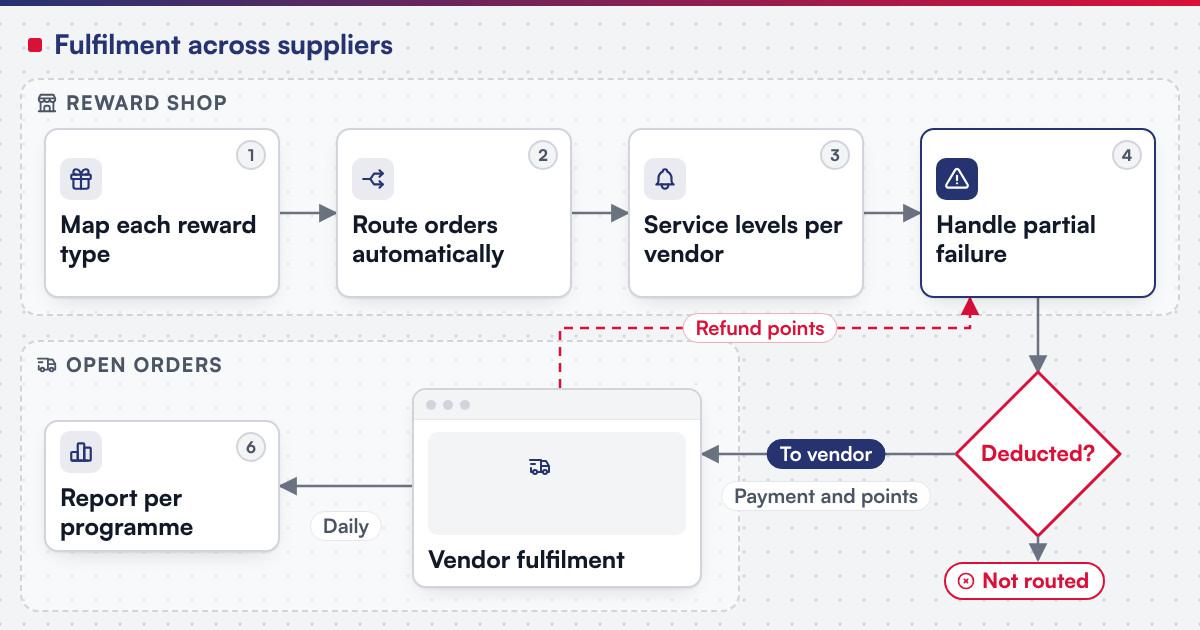 (opens the full-size diagram in a new tab)
Worked scenario: a second programme joins the platform
A rewards operator runs one bank's reward shop and signs a retail chain as its second client.
- Weeks 1-2. The team agrees the retail chain's conversion rate, points-plus-cash rule and reward catalogue. Most merchandise is shared; gift cards are specific to the chain.
- Weeks 3-5. A new branded shop is created on the existing platform, with its own theme, domain and single sign-on from the chain's app. The chain's points middleware is connected through the same webhook pattern as the bank's.
- Weeks 6-7. Vendor routing is extended to two new gift card suppliers with their own service levels. Reconciliation reports now split by programme.
- Week 8. A limited launch to one member tier runs for two weeks before the full programme opens.
The timings are illustrative. The pattern is that the second programme reuses the catalogue, order engine and routing, and adds only branding, integration and rules.
What has Netbase built in this area?
The published record is the loyalty reward shop platform. For a Dubai-based loyalty and rewards technology company (not named), Netbase delivered a headless multi-store reward shop platform on Magento 2 Open Source with a Next.js front end: individually branded reward shops per client programme, a hybrid points-plus-cash checkout, merchandise, gift cards and travel bookings, a multi-vendor module with fulfilment routing and service-level breach alerts, Arabic and English, integrations with the client's points middleware, ordering service and product catalogue by webhook and scheduled sync, single sign-on, payment gateways, mobile SDK interface components for client apps, a centralised super-administrator dashboard and AWS or on-premise deployment, in four phases over 3.5 to 4.5 months. The record describes delivered scope; the engagement is under NDA, so no client, programme or partner is named.
Netbase delivers remote-first from Hanoi in Agile increments with weekly reviews, using AI-assisted engineering under human review. For programmes run from the Gulf, the UAE software delivery guide covers the market-specific questions to settle before a build.
Where does loyalty fit in retail and commerce?
Loyalty sits on top of the retail stack rather than beside it: it depends on customer identity, order history, catalogue data and payment. The retail, commerce and marketplaces page describes the sector's workflows and where a first project usually starts. Where the job is managing people who join, renew and contribute to an organisation rather than customers earning and redeeming points, that is membership and community platforms, a different system this guide does not plan. If the reward shop will run on an ageing commerce platform, the ecommerce platform modernization checklist helps decide whether to modernise that platform first.
Which questions should you ask a supplier?
- How does checkout reserve, deduct and reverse points in our ledger? Ask for the sequence, including failure cases.
- Can one platform serve several branded programmes? Check branding, domains, sign-on and reporting per programme.
- How are vendor service levels tracked? Look for alerts before breach, not reports after.
- Which rewards are digital, and how are codes stored? Gift card codes are valuable and need protection like payment data.
- How are abuse and automated redemption limited? Expect per-member limits and monitoring.
- Where can the platform be hosted? Programme owners in regulated sectors may require their own environment.
- How is programme liability reconciled? Daily reconciliation across orders, points and vendor invoices is the expected answer.
What goes wrong with reward platforms?
- Points deducted, order failed. Signal: members complain of missing balances. Owner: the engineering lead, who designs reservation and reversal before the storefront.
- One programme's rules leak into another. Signal: a member sees rewards meant for a different client. Owner: the product owner, who tests eligibility per programme.
- Vendors miss delivery silently. Signal: complaints arrive before alerts. Owner: operations, who set service levels per vendor.
- Scarce rewards drained by bots. Signal: limited items vanish within seconds. Owner: security, who add limits and monitoring.
- Reconciliation left to month-end. Signal: finance cannot state the programme's liability. Owner: finance, who require daily reports.
Plan the next step for your project
Common questions
Only if the shop is the programme. When a bank, airline or retailer already runs a points ledger, the shop should call that ledger rather than copy it, so there is one source of truth.
Not for one shop with modest branding. It becomes useful when several programmes need their own front ends, app components or channels on one catalogue and order engine.
Yes, with a points-plus-cash checkout. Define the minimum points share and how refunds split between points and card before building.
It depends on integrations and the number of programmes. The published Netbase record was delivered in four phases over 3.5 to 4.5 months.
Yes, when it is planned from the start; the published record supports Arabic and English.
Plan your reward platform with us
Bring your programme structure, points system and reward catalogue. Custom product engineering is the delivery route. OutsourcingVN is Netbase's own outsourcing-services platform. Submit a project, and a person will reply with a phased scope and the integration questions to settle first.
Work behind this guide

Confidentiality covers the engagement; no client is named and no result is claimed.
Keep ReadingRelated services and solutions
 Custom product engineering for a bounded release outcome
One defined release of your product, built to named outcomes and handed over with acceptance evidence.
Learn More